
Amazon's Qualcomm deal makes chip orders the financing test
Amazon and Qualcomm have linked custom AI data-centre silicon and 1.6T optical connectivity to a warrant whose vesting follows commercial orders and purchases.
Amazon's new Qualcomm agreement ties a custom AI-inference chip programme to an unusually explicit commercial test: Amazon's right to acquire Qualcomm shares vests as it places binding orders and buys qualifying server products, technology, systems and manufacturing services.
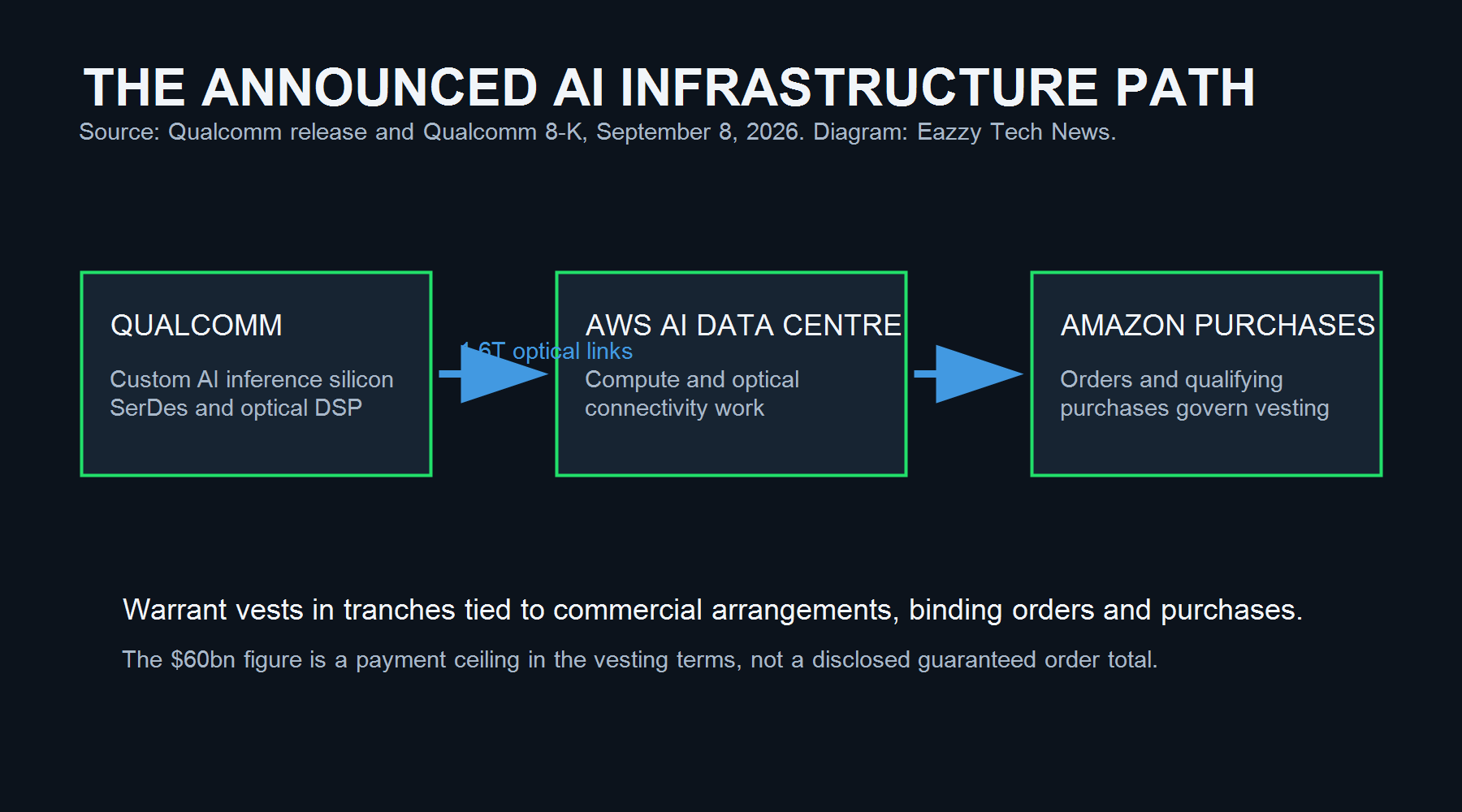
Qualcomm announced on September 8 that it will work with Amazon across multiple generations of customised silicon for large AI data centres, with inference as the named workload. The companies also plan optical links reaching 1.6 terabits per second, using Qualcomm's SerDes and optical digital-signal-processing technology.
The partnership gives Qualcomm a route into AWS infrastructure beyond its established phone-chip business. It gives AWS another supplier relationship around the chips and links inside AI clusters. The announcement does not name a processor, an AWS service, a deployment date, a volume commitment or a performance target.
Orders determine how much of the warrant vests
A Qualcomm 8-K filed with the US Securities and Exchange Commission adds the commercial structure missing from the press release. Qualcomm issued Amazon a warrant for up to 25 million shares at an exercise price of $161.26 each. The warrant can vest in tranches through commercial arrangements, binding purchase orders and actual purchases, up to $60 billion in payments during its term.
That $60 billion is a ceiling tied to the vesting conditions, rather than a disclosed guaranteed order total. The filing says 3.75 million shares vested on issuance because of initial purchase commitments. It also says the warrant expires in September 2036 and gives Amazon no voting rights while unexercised.
Reuters reported that the warrant was worth about $4 billion at the stated exercise price and linked it to the purchase conditions in the filing. The figure is a value of the potential share purchase at that price, not a cash payment from Amazon to Qualcomm.
Inference and the network sit in the same deal
The technical scope matters because inference clusters need more than accelerator throughput. Models running for users move data among compute, memory and storage, so the links between machines can constrain a rack even when the processors have unused capacity. Qualcomm says the optical work will extend to 1.6T, but it has not said which products will ship, whether the links are for a particular AWS generation, or when customers will see them.
What the 1.6T reference does and does not describe
A 1.6T figure describes the planned scale of an optical connectivity solution, expressed as 1.6 terabits per second. It does not identify the number of ports, the topology inside a rack, the distance covered, latency, power consumption or the data rate available to a single model. Those details decide how a component fits into a production cluster, and none is in the announcement.
Qualcomm named two building blocks: SerDes, circuits that serialize and recover fast electrical data streams, and optical DSPs, processors that help send and receive those streams over fibre. The pairing signals that the companies are considering the path between systems alongside the compute silicon. It does not establish that Qualcomm will supply every link or processor in an AWS AI deployment.
The companies also plan to use AWS AI infrastructure, including Amazon Bedrock, for Qualcomm electronic-design-automation workloads. Qualcomm says that use targets shorter chip-design cycles. That is an intended outcome, not a published measurement of time saved.
For AWS, the arrangement joins compute, interconnect and supplier incentives in one programme. For Qualcomm, the crucial evidence will arrive through the purchase orders and products that follow. Until then, the confirmed news is a multi-generation collaboration and a purchase-linked warrant structure, rather than proof that a new AI chip is already deployed at scale. Public product disclosures will determine how much of the proposal becomes usable capacity.



Comments ()