Why is Gemini 4 Argon reaching cyber defenders before everyone else?
Gemini 4 Argon is reaching trusted cyber defenders first. Here is what Google has announced, what its scores show and what wider access still awaits.
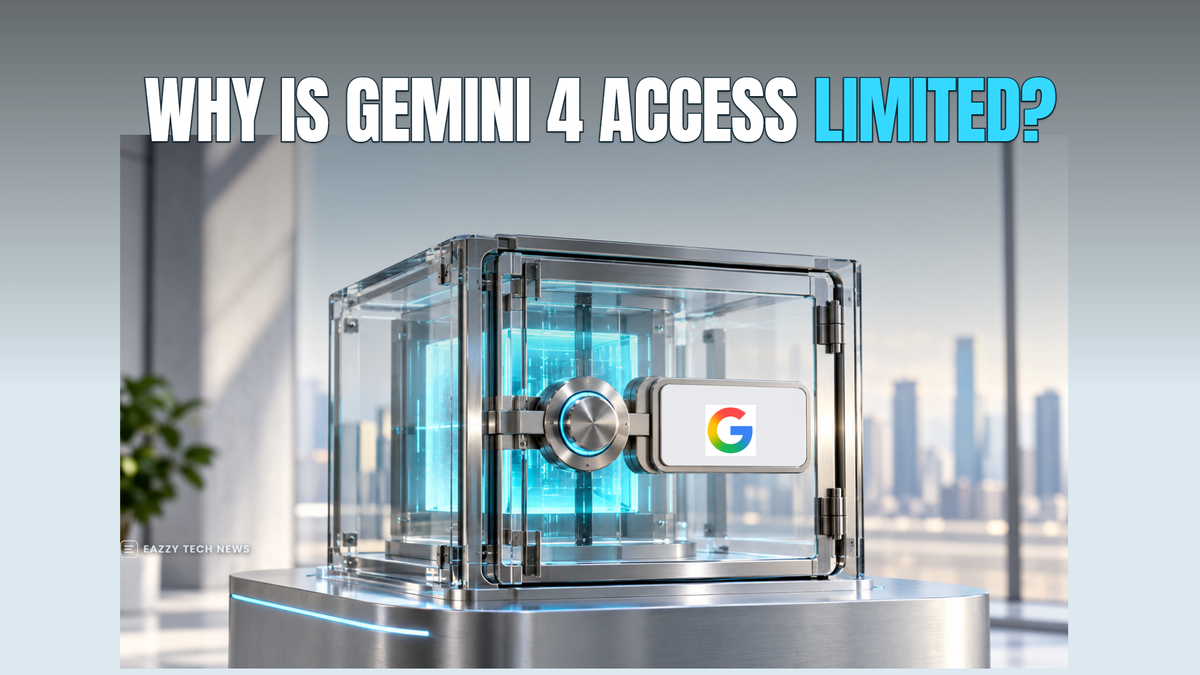
Google is giving trusted cybersecurity defenders and its own teams access to Gemini 4 Argon before opening the model more widely. The phased rollout means the announcement is ahead of general access: most developers and subscribers still have to wait.
In its September 30 announcement, Google says it will expand access while gathering feedback, refining safeguards and engaging with the United States' voluntary programme for access to models before release. Paid application programming interface (API) customers and Google AI Ultra subscribers are named for a later wider launch. An API lets software send requests directly to a model; it is separate from using a consumer chat app.
Who gets access first?
The first external cohort consists of trusted cyber defenders using Google's Fairwind programme. Google is also using Argon internally. Axios reports the same restricted initial rollout. Neither the announcement nor that report supplies a firm date when ordinary customers will gain broad access.
Google says these limited groups can use the model without its cybersecurity guardrails so they can examine its capabilities and help harden the eventual product. That describes a controlled cohort, not an unrestricted release to the public. A business planning to adopt Argon should therefore separate the published feature claims from the access it can actually obtain.
What do the coding scores show?
Google reports a 77.9% score for Argon on DeepSWE v1.1, a benchmark for software-engineering tasks that require multiple steps. Its chart places GPT-6 Astra at 74.1% and Claude Opus 5.5 at 74.2%. Those figures support a claim about this particular test, under its evaluation conditions. They do not mean Argon will correctly complete 77.9% of every team's coding work.
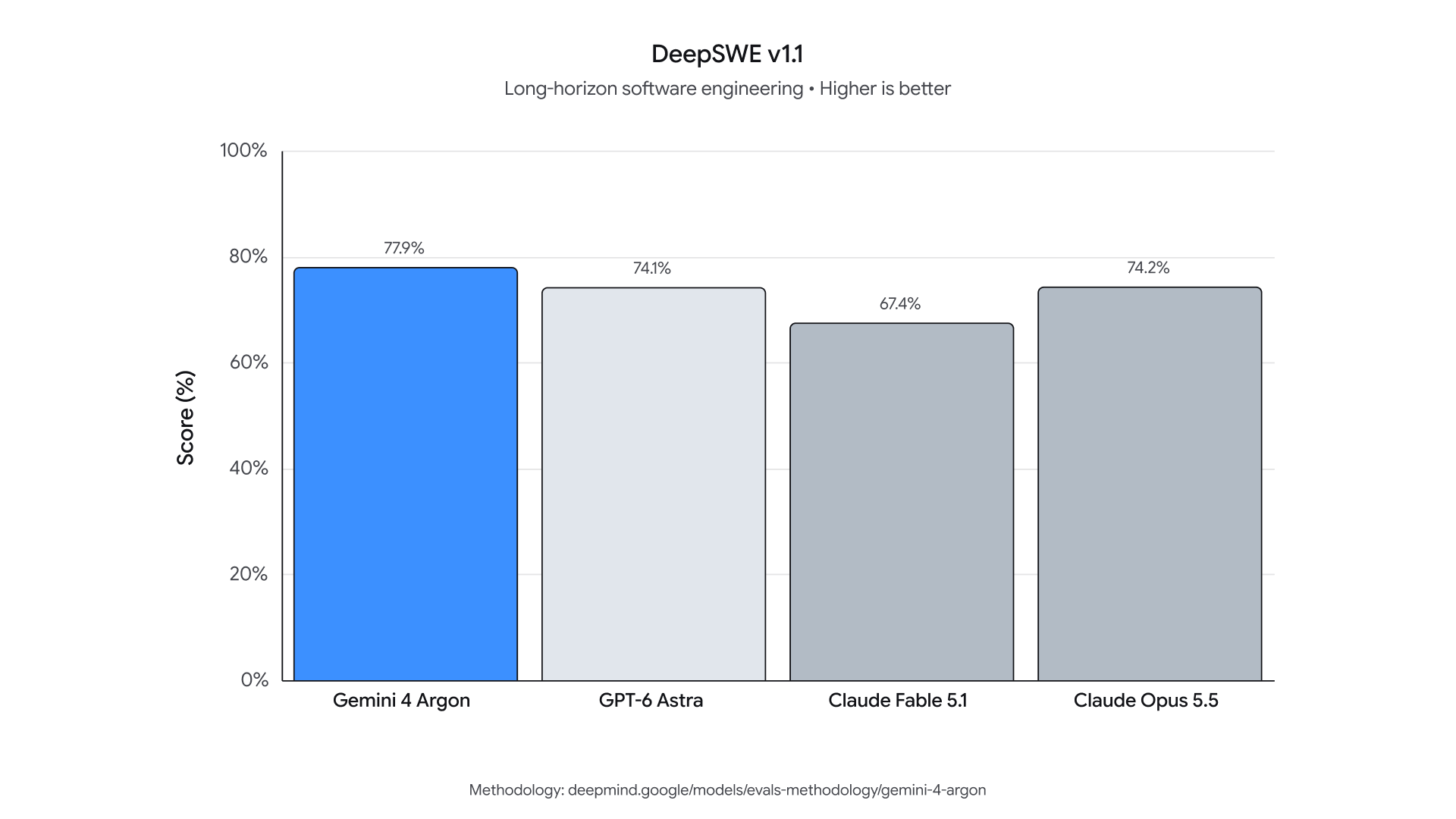
The results are company-reported comparisons. They are useful evidence of what Google is claiming, but this announcement does not establish independently replicated performance across real codebases, security requirements or deployment environments. A higher benchmark score leaves those practical tests to be done.
Why the economic weighting needs care
A second Google chart gives Argon a score of 68.9 on the Vals Index. This evaluation combines tasks across sectors such as finance, coding, law and tax, weighted by their contribution to United States gross domestic product (GDP), a measure of economic output.
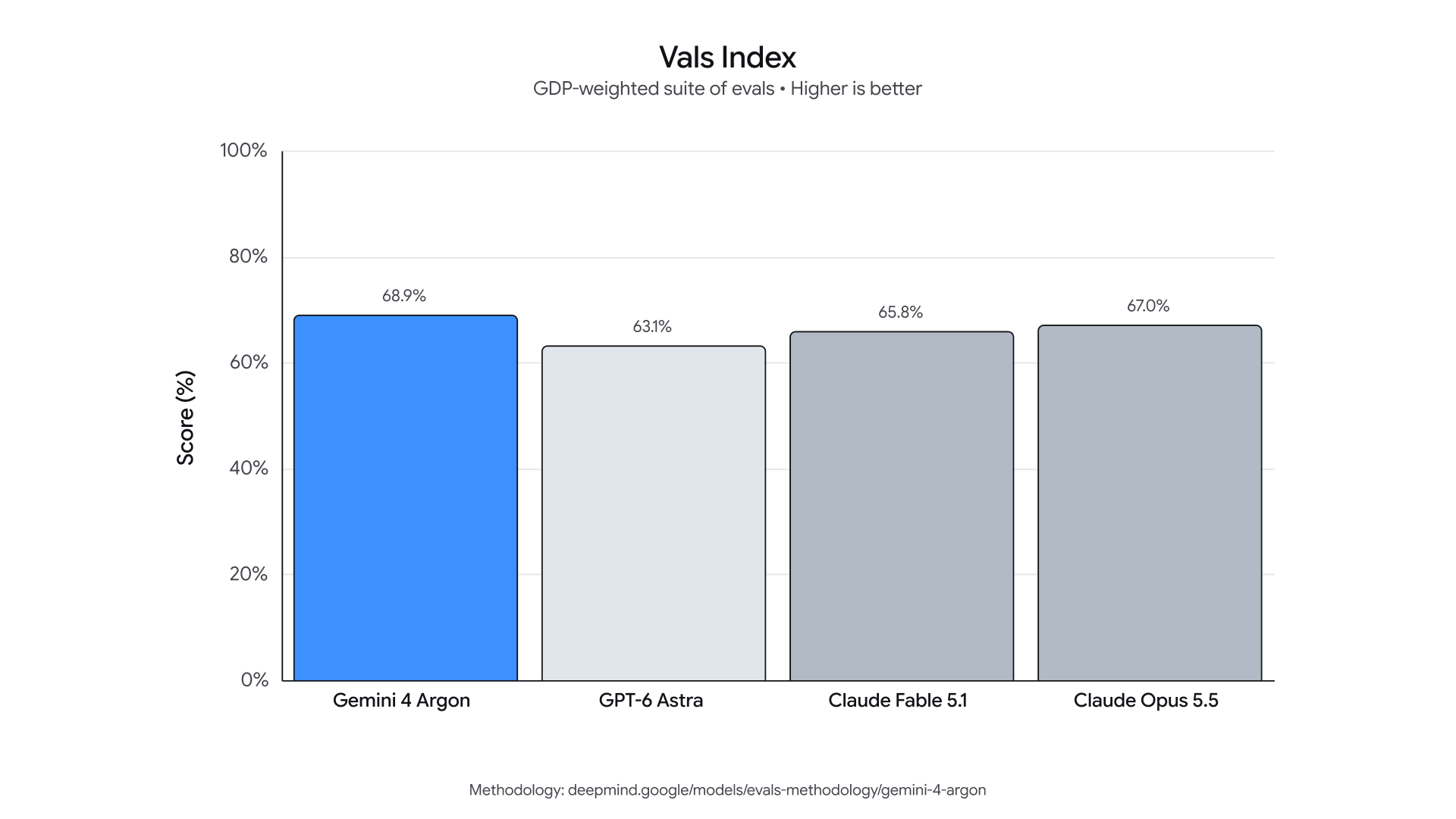
The weighting changes how much each sector's tasks contribute to the combined score. It does not measure an increase in GDP, prove a return on investment or show that a company can replace professional review. Google reports an evaluation result; real economic gains would require separate evidence of how people use the model and what happens afterward.
What is announced for the wider release?
Google announces introductory pricing of $2 per million input tokens and $10 per million output tokens, with a 95% discount for cached tokens. Tokens are small chunks of text or other data a model processes; a token is not necessarily a whole word. Caching reuses eligible previously processed input. These are announced launch prices, not proof that the wider service is available now.
The company also says the output limit will rise from 64,000 tokens to one million. That is the amount the model can generate, not a claim about how much input it can accept in a single request. The distinction matters when comparing models for long documents or extended software tasks.
Google describes layered defences against prompt injection: malicious instructions hidden in outside content that try to redirect a model. Those defences are part of its release plan, not evidence that every attack is prevented.
The immediate development is a cybersecurity-first access programme. The next material step for most prospective users is a confirmed wider release, with usable access and documented safeguards. Until then, Argon's reported results are reasons to evaluate the model when access arrives, not a promise of identical results in production.

Comments ()