
Irish courts put human verification at the centre of AI filings
Ireland's High Court and Court of Appeal now require independent verification of AI-assisted court material, with declarations for witness statements and expert reports.
Ireland's High Court and Court of Appeal now require people who use generative AI in civil filings to verify its output independently, putting responsibility for accuracy back on the person who signs or submits the document.
The Courts Service announced that the two practice directions took effect on September 1. They apply to civil court documents prepared after that date, including pleadings, submissions, affidavits, witness statements and expert reports. They cover lawyers, parties, witnesses, experts and people representing themselves.
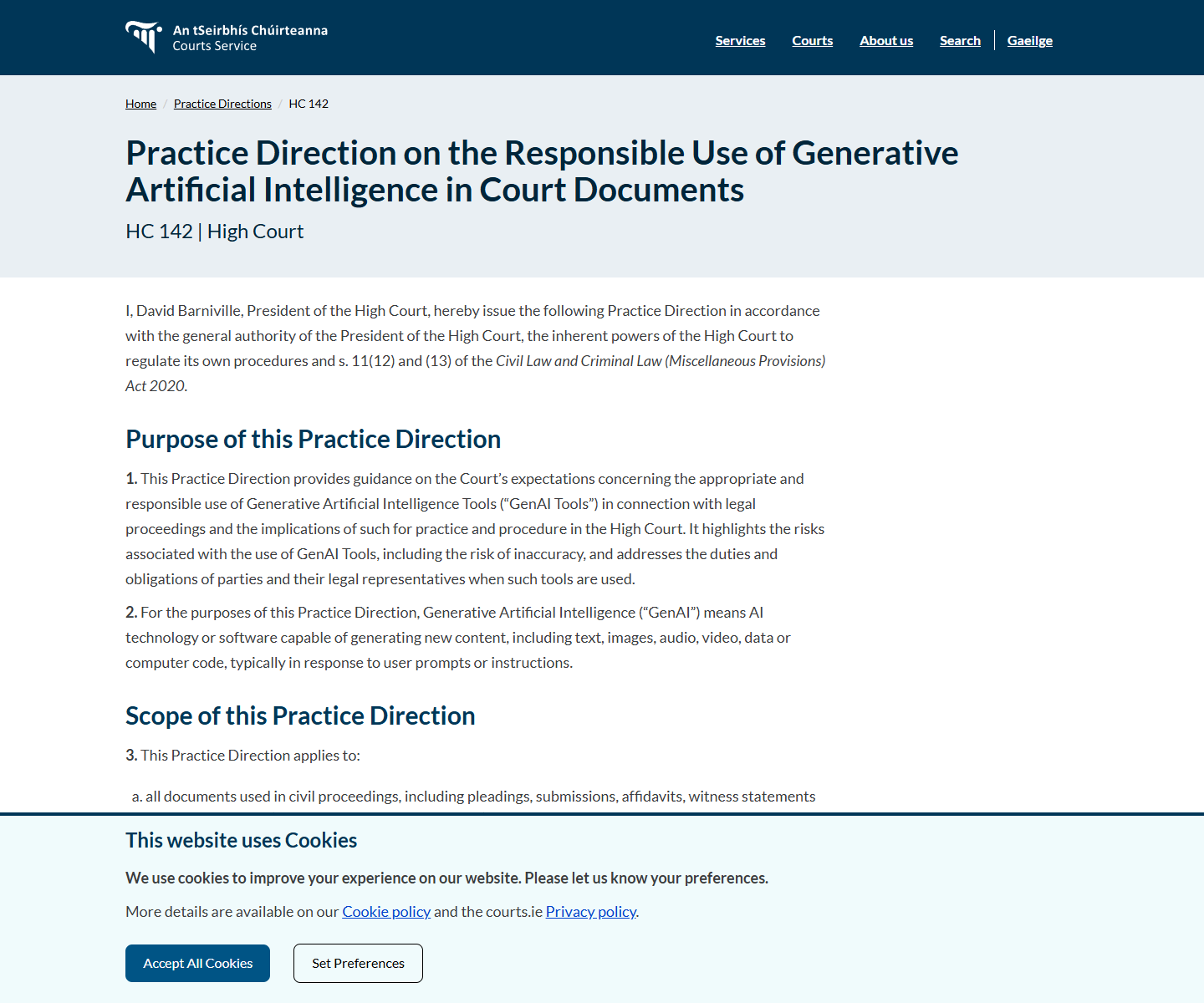
The rule does not ban generative AI. It says users remain responsible for their court documents and cannot use another AI tool as the check. The directions call for fact-checking, proofreading and verification that cited cases, legislation, books and articles exist and support the legal point made.
They also address evidence. Parties must take particular care with exhibits, images and recordings, and the directions say fabricated or manipulated material must never be presented to the court. A court can require disclosure of whether AI was used and how far it shaped a filing.
Witness statements and affidavits carry a tighter safeguard. Unless a court directs otherwise, the witness must declare that generative AI did not generate their substantive evidence and that the account reflects their own knowledge and recollection. Expert reports need a similar declaration; material AI use in drafting, analysis or interpretation must be disclosed so the court can assess reliability and independence.
People without lawyers face the same standards. The directions tell self-represented litigants to check AI output against reliable and authoritative sources, including court and law-reform websites. A document with invented cases or inaccurate references can still trigger sanctions. The Court of Appeal direction says the rules apply even where a case began before the new directions, if the document itself was prepared after the commencement date.
The directions preserve the possibility of AI for administrative work such as formatting and spell-checking. They also acknowledge that the tools may reduce litigation costs and improve access to justice. That permission comes with a clear boundary: the filing party, not the software, is accountable for what reaches the court.
Non-compliance can bring adverse costs orders, rejected documents or, where appropriate, a struck-out claim or defence. Lawyers can also face referral to a regulator or professional body. The courts say they will keep the approach under review as the technology changes.



Comments ()