
Lesotho's farmer registry gives AI a public-service test
Lesotho has launched a national Farmers Portal for agriculture records, giving AI-assisted public-service delivery a grounded test in farmer registration.
Lesotho's Ministry of Agriculture, Food Security and Nutrition has launched the Lesotho Farmers Portal, a national registry meant to replace scattered paper, spreadsheet and district-level records with one system for farmer and land information.
The launch was announced on August 30 in a release distributed by Joget, whose platform underpins the system. The ministry led the launch with Vodacom Lesotho, while FiscalAdmin delivered the portal on Joget DX Enterprise. The release also names ITU, GovStack and the World Food Programme as programme or implementation partners.
The practical change is straightforward. Field officers across Lesotho's 10 districts are expected to register farmers and land parcels, including household details, farming activities, livestock, assets, support services and GPS boundaries. Ministry staff can then search and review that information centrally.
The release also gives a useful map of the public-service stack behind the launch:
- The agriculture ministry owns the registry, the data and the process.
- ITU supplied the programme framework and digital-government methodology, while GovStack supplied the Registration Building Block specification and reference architecture.
- The World Food Programme supported the implementation, including the Joget DX Enterprise licence, and Vodacom Lesotho partnered on the launch and field reach.
For now, this is less a story about an AI deciding farm policy than about AI-assisted public-service delivery. FiscalAdmin says the project used large-language-model-assisted, specification-driven development: an assistant worked against a written specification, results went through the platform API, and an automated test suite checked releases before changes reached the system. When a fix was needed, the release says the team updated the specification rather than patching the live system directly.
That distinction matters because public services do not get the same room for failure as consumer software demos. A farmer registry touches identity data, land records and future eligibility for support. If the underlying data is wrong, later services can become harder to challenge. If the system works, the ministry gains a clearer base for planning agricultural programmes and distributing inputs.
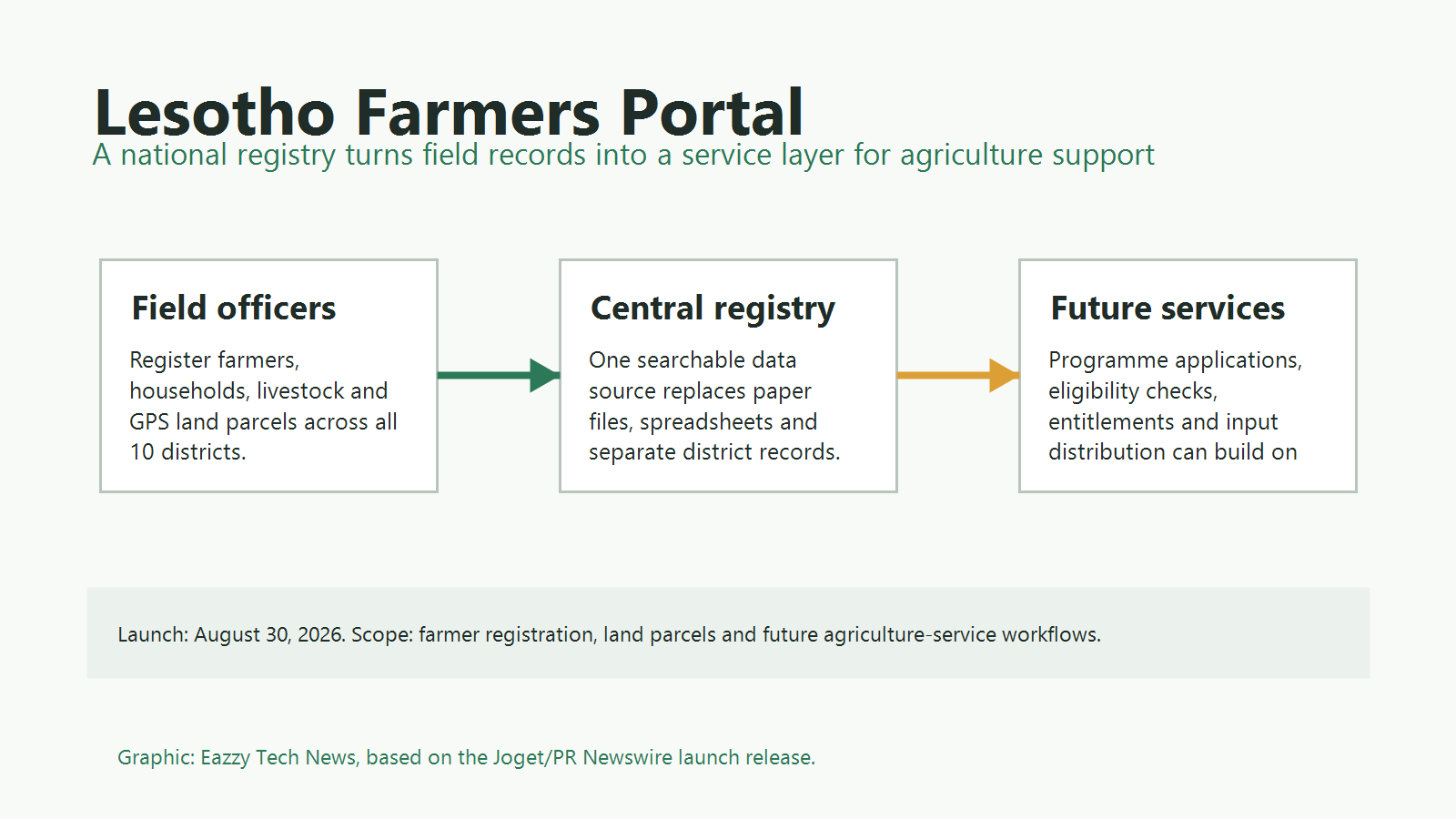
The Government of Lesotho describes the agriculture ministry's mandate as promoting agricultural production and food security. The new portal fits that job only if registration turns into usable services. The release says the wider platform already has capabilities for programme applications, eligibility evaluation, decision management and entitlement issuance, but those are framed as future additions after national registration expands.
Joget's broader pitch is that its agentic AI application platform combines visual app building, AI agents, workflow automation, integrations and governance controls. GovStack, meanwhile, says its building-block specifications are meant to help governments assemble reusable digital public infrastructure rather than rebuild every service from scratch.
That matters after launch. The release says the portal lets ministry staff manage forms, lists, workflows, user access and reference data through configuration. In plain terms, future updates to districts, villages, crops, livestock types or document types should not always require a developer. That is a smaller claim than "AI transformed agriculture", but it is the claim that public agencies can test: can a small ICT team keep a national registry accurate after consultants and vendors leave?
The unresolved point is outcome, not launch. The release does not yet provide registration totals, farmer-service uptake, error rates, audit results or evidence that farmers are receiving support faster. Those measures will determine whether the portal becomes a durable agriculture-service layer or just a cleaner database.
Still, the launch is a useful test of where applied AI may matter most in public administration. The headline use is not a chatbot answering policy questions. It is a small delivery team using AI-assisted tools and reusable building blocks to move a national service from fragmented records toward a maintained registry. For governments with limited technical capacity, that is the claim worth watching.


Comments ()