
Astra's ARC score depends on the harness
ARC Prize's Astra evaluation shows why frontier-agent scores need their harness, memory condition, action count and cost beside the headline number.

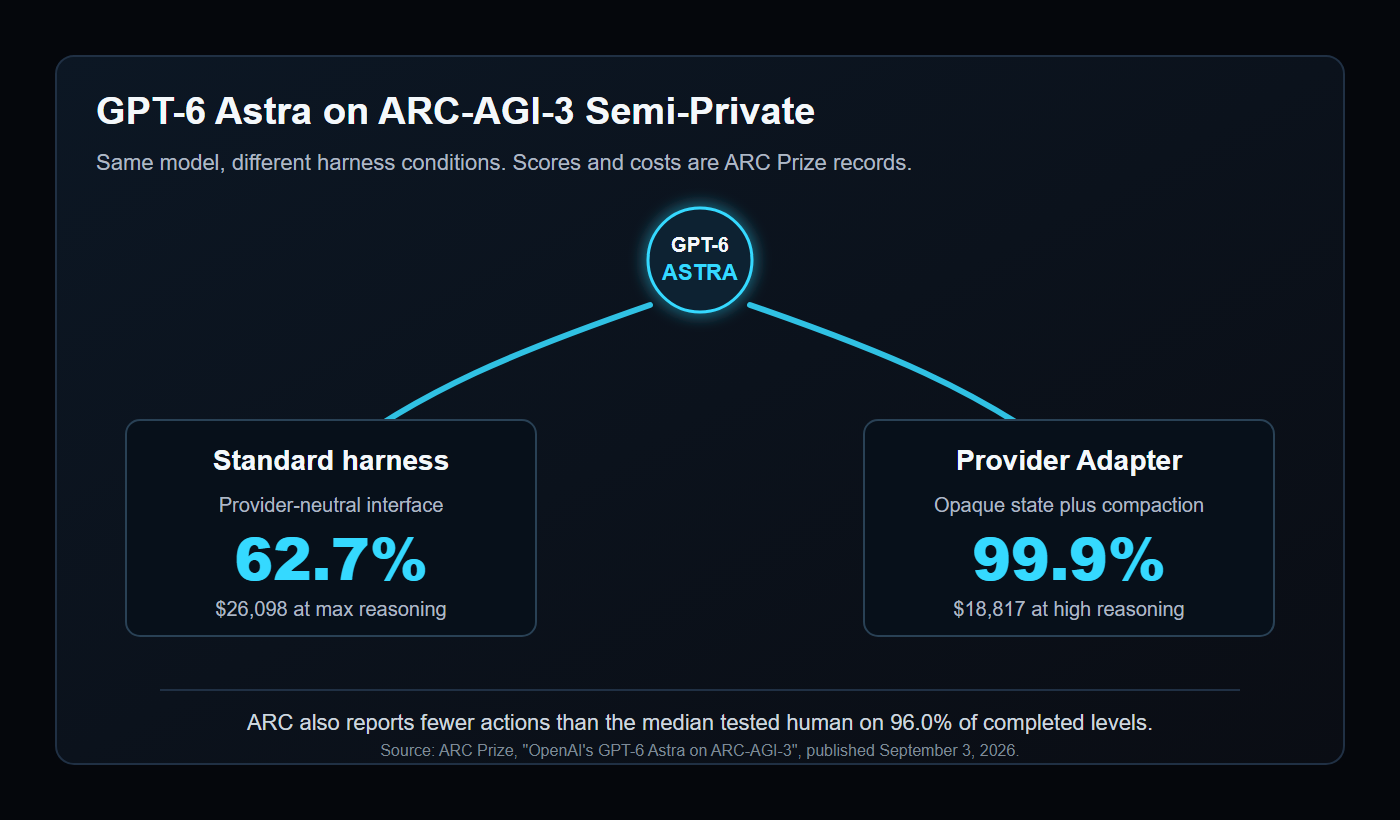
ARC Prize says OpenAI's GPT-6 Astra reached 62.7% on ARC-AGI-3 with a provider-neutral harness and 99.9% with a provider-adapter harness, making the test setup part of the result readers need to understand.
ARC published the evaluation on September 3, 2026. ARC-AGI-3 tests agents in novel, abstract, turn-based environments where they have to explore, infer goals, model the rules and plan actions without explicit instructions. ARC says humans can solve all of the environments, and that it built its action-efficiency baseline from roughly 500 members of the general public.
Why the harness changes the score
The Standard harness gives a model a provider-neutral interface and lets it carry forward visible notes it chooses to keep. The Provider Adapter harness preserves opaque reasoning state between requests and uses compaction for longer conversations. Those conditions answer different questions: how the model performs through a common interface, and how it performs when its provider's memory and context machinery are part of the run.
Under the Standard harness, ARC reports Astra at 62.7% on ARC-AGI-3 Semi-Private at max reasoning effort, with recorded cost of $26,098. Under the Provider Adapter harness, ARC reports Astra at 99.9% at high reasoning effort, with recorded cost of $18,817. ARC says higher reasoning effort can cost less in this benchmark when the model solves games in fewer actions, because fewer actions can mean fewer calls and fewer tokens.
The human-efficiency claim is narrower than AGI
The most striking ARC finding is about actions, not only completion. In the Provider Adapter harness, ARC says Astra at max reasoning used fewer actions than the median tested human on 96.0% of completed levels and used 51.7% fewer actions per level on average. That does not mean Astra is generally more capable than humans outside the benchmark. It means that, in ARC's closed environments and under that harness, Astra often needed less interaction once it found the mechanics.
ARC also describes a behavior that matters for agent design: Astra turned unfamiliar game mechanics into compact symbolic notes. The post shows examples where the model tracked coordinates, operations, turn state and multi-step plans in its own shorthand. ARC frames this as an on-the-fly algebraic shorthand, not a full programming language.
OpenAI's Astra launch page cites ARC-AGI-3 alongside other benchmark claims and says Astra is rolling out first to a limited set of organizations before wider availability. OpenAI's system-card page adds safety context around the model's deployment. Those pages are company sources, so the ARC result should still be read through ARC's evaluation labels, cost records and stated limits.
The practical consequence is simple: frontier-agent benchmarks now need to publish the harness, memory conditions, action counts and cost beside the headline score. Without those labels, a 62.7% result and a 99.9% result can look like a contradiction when they are evidence from different test conditions.



Comments ()