
Googlebook turns Android's laptop pitch into real hardware
Googlebook pre-orders are open, with five premium models from Acer, ASUS, Dell, HP and Lenovo built around Gemini Intelligence and Android continuity.
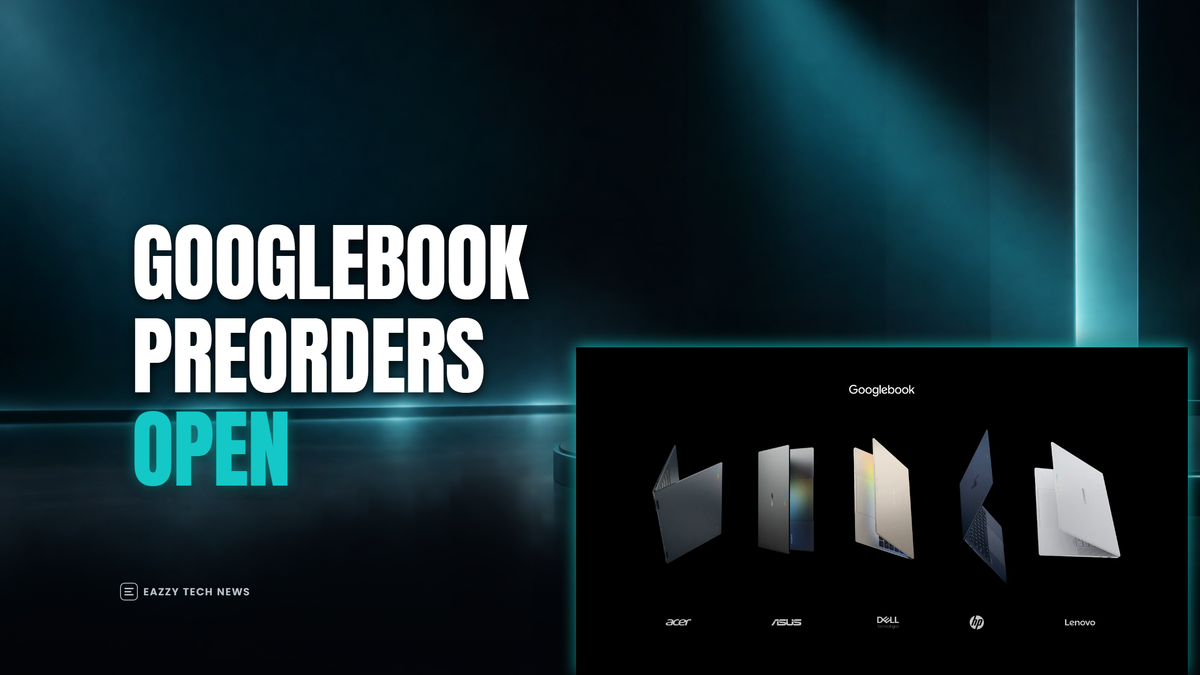
Google has moved Googlebook from teaser to retail product, opening pre-orders for five premium laptops that put Gemini, Android phone continuity and a new Googlebook OS at the center of the laptop pitch.
The September 21 pre-order announcement says Googlebooks are available to order now and reach shelves on October 4 in the U.S., then October 5 in Canada, the U.K., Ireland, France, Germany and Australia. A companion hardware post says the lineup starts at $899 and includes models from Acer, ASUS, Dell, HP and Lenovo.
This is not a Chromebook refresh with a new sticker. Google is trying to create a premium Android-aligned laptop category that sits above mainstream Chromebooks and competes more directly with MacBooks and Windows ultrabooks.
What Googlebook is
Google describes Googlebook as a new laptop category built for Gemini Intelligence. The official Googlebook product site presents the devices as laptops designed around Google's AI layer. The machines combine Android's app base and phone ecosystem with desktop foundations from ChromeOS, while using a new Googlebook OS and premium hardware rules for partner laptops.
The first lineup is deliberately narrow:
- Acer has the convertible model that shifts between laptop and tablet use.
- ASUS focuses on portability, with a 2.2-pound design.
- Dell gets the balanced premium model with a flashier look.
- HP leans into a polished design that Google describes as elegant open or closed.
- Lenovo has the larger 15-inch productivity model.
Across the portfolio, Google says the machines use aluminum, magnesium alloy or carbon fiber; touchscreens up to 2.8K resolution; backlit keyboards; haptic glass-feel trackpads; studio-quality microphones; and up to six speakers with Dolby Atmos. The base memory floor is 16GB of high-speed RAM, with some models reaching 32GB.
Why the hardware matters
Google says launch configurations use Intel Core Ultra Series 3 and Snapdragon X Elite processors, with advanced neural processing units above 45 TOPS for on-device AI work. TOPS means trillion operations per second, a common shorthand for how much AI math a chip's neural engine can handle. It does not automatically prove real-world speed, but it signals that Google wants local AI features to run without every task going to the cloud.
The most visible hardware flourish is the Glowbar, a light strip that shows boot, battery and other patterns. Google says developers will be able to build custom interactive Glowbar animations. That is playful, but it also gives Googlebook a physical identity beyond being another thin silver laptop.
The AI software layer
Google's built-in intelligence post frames the laptop around Gemini features rather than raw specifications. Magic Pointer is designed to give contextual suggestions when a user points at on-screen content. Rambler turns voice dictation into cleaner writing. Antigravity is described as a way to automate multi-step work across apps.
The phone-continuity angle is just as important. Googlebook is meant to sync tightly with Android phones, so users can move work between devices, reach phone files and use mobile apps in a more laptop-like environment. That is Google's clearest Apple-style ecosystem argument: Android phone owners should have a laptop that feels native to their phone and carries phone context into desktop work.
What still needs proof
The strongest claim is also the hardest one: whether Android apps, web apps, Linux tools and Gemini features can add up to a laptop people choose over a MacBook or Windows PC. Google can control the operating system, the baseline hardware rules and its own AI features. It still needs app developers, accessory makers and enterprise buyers to treat Googlebook as a serious desktop-class platform.
The launch package gives Google a clearer laptop story than Chromebooks ever had at the premium end. The next evidence will come from the first retail models: battery life, app quality on large screens, performance under real creative workloads, Android phone handoff reliability and whether Gemini features feel useful after the demo glow wears off.

Comments ()