
GPT-6 Astra reaches Copilot with new billing and policy choices
GPT-6 Astra is now generally available across GitHub Copilot, adding a usage-priced model with default-on enterprise policy implications.

GitHub has made OpenAI's GPT-6 Astra generally available across GitHub Copilot, giving paid users a new model choice while placing a fresh pricing and access-policy decision in front of teams.
The September 4 release covers Copilot Pro+, Max, Business and Enterprise. GitHub says the rollout is gradual, so an eligible user may still have to wait for Astra to appear. Copilot Free and Pro are absent from the availability list.
This is a broad product release rather than another routing experiment. Astra can be selected in Visual Studio Code, Visual Studio, Copilot CLI, the GitHub Copilot coding agent, the Copilot app, github.com, GitHub Mobile, JetBrains IDEs, Xcode and Eclipse. That list spans local editors, mobile access and GitHub's cloud agents. The recent HydraFusion research preview examined how Copilot can route work through several models; Astra's release concerns one model's plan coverage, surfaces, billing and administrator controls.
Availability across ten surfaces does not make those experiences identical. An editor chat, a command-line session and a coding-agent job expose different tools and context around the selected model. General availability says where eligible users can choose Astra; it does not promise equal behavior in each product. A useful team evaluation should use representative repositories, require the normal tests to pass and record token spend alongside the result.
A premium model with token-based pricing
GitHub calls Astra OpenAI's latest general-purpose model and says it is designed for long-horizon autonomous coding and agentic tasks. The company also says its internal tests found stronger long-horizon results with fewer steps than earlier OpenAI models because Astra planned, validated and checked its work as it progressed. GitHub's announcement gives no benchmark table, test set or independent evaluation for that comparison. Readers should treat it as GitHub's internal assessment.
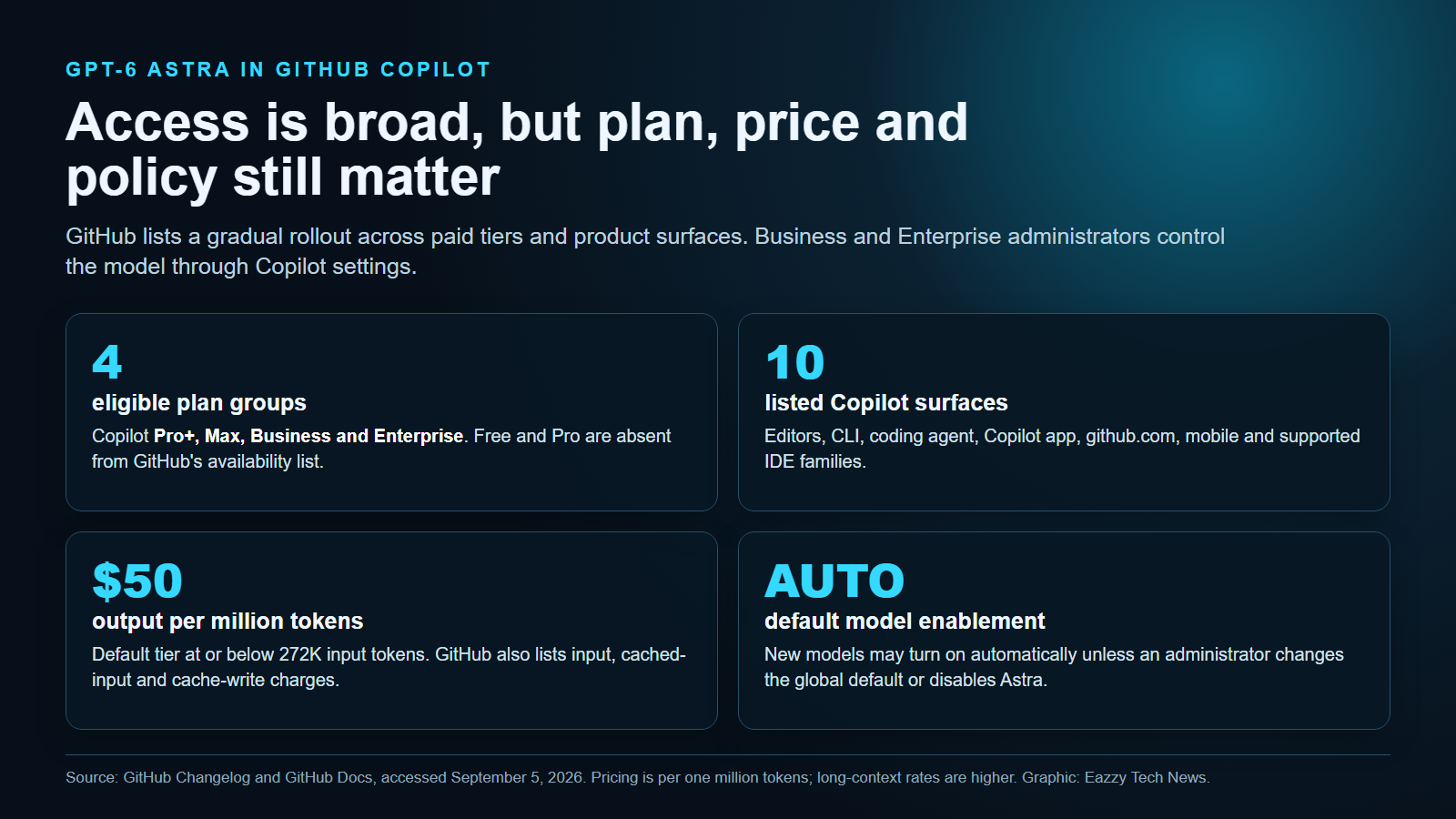
The price matters because Astra uses provider list pricing under Copilot's usage-based billing. GitHub's current table prices one million tokens at $10 for input, $1 for cached input, $12.50 for cache writes and $50 for output when a request stays at or below 272,000 input tokens. Above that threshold, the listed rates rise to $20, $2, $25 and $75 respectively.
Copilot converts token charges into GitHub AI Credits, where one credit equals $0.01. Individual paid plans carry different included allowances. Business and Enterprise allowances are pooled per billing entity, and extra use beyond an allowance can add charges. A long agent session can therefore cost more than a short chat even when both begin with the same model selection. Teams need usage reports and budgets alongside model access.
The default policy can enable Astra automatically
Business and Enterprise administrators have a second job: check the model policy. GitHub's default-availability system can enable newly released Copilot models automatically. An organization inherits that behavior unless an administrator turns off the global default or disables Astra specifically.
That arrangement speeds access for teams that accept new models by default. It can also widen the approved model set before procurement, security or engineering leaders have reviewed price and use cases. Organizations with tighter controls should inspect both enterprise-level and organization-level settings, because enterprise policy can govern whether organizations may choose their own model access.
Developers also need to match Astra to work that can justify its rates. GitHub's supported-model list records Astra as generally available, while its pricing page classifies the model as powerful and gives it a long-context tier. Those labels describe GitHub's catalogue. They do not establish that Astra is the best or cheapest choice for every coding task.
Eligible individual users can watch the picker during the gradual rollout. Company administrators should review Astra's policy state, allowances and overage controls before broad use begins. Evidence about coding quality will need public, reproducible comparisons beyond GitHub's internal tests.



Comments ()