
HydraFusion makes Copilot choose the coding workflow
GitHub's HydraFusion preview turns Copilot model choice into a runtime routing decision for agentic coding tasks, with cost and validation attached.

GitHub has opened HydraFusion as a research preview in Copilot CLI, giving developers a single Copilot option that can choose whether a coding task needs one model call, an escalation path or an independent critique before the answer comes back.
The company introduced Project HydraFusion on September 4, 2026. GitHub says the preview creates a full execution plan, then selects models across providers to draft, critique, revise or cascade to a stronger model. The user still selects HydraFusion like a model. The routing happens inside the runtime.
That changes the model-choice problem. GitHub already offers multiple Copilot models with different strengths, including GPT-6 Astra for long-horizon coding and agentic tasks. HydraFusion treats that menu as raw material for a workflow. It can send simple work through one model, let a cheaper model try first and escalate only when a quality gate fails, or ask a separate model family to review a draft before the original solver revises it.
The route is the product
GitHub says new Copilot models can inherit default availability policies for Business and Enterprise customers unless administrators configure them differently. HydraFusion adds another layer to that policy question: a team may approve a model, then let a runtime decide when to use it inside a compound workflow.
The current preview has three patterns. Single sends the task to one selected model. Cascade lets an efficient model draft first, then escalates when the result misses the bar. Critique asks a separate, read-only critic to review the answer before the drafting model revises it. GitHub says the workflow uses signals for reasoning, code generation, debugging and tool use to choose the route.
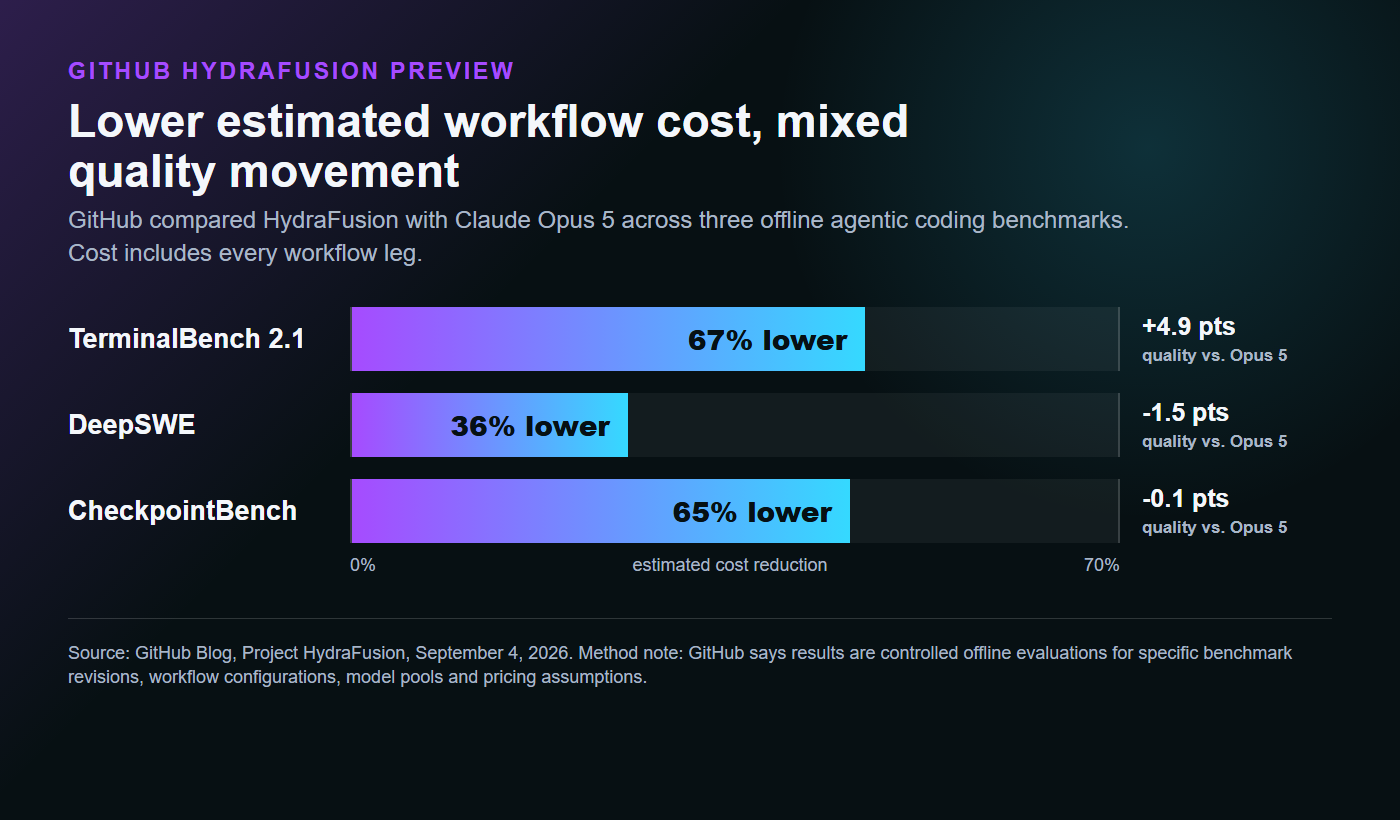
The benchmark claims are specific and limited. GitHub says fixed HydraFusion policies were tested on TerminalBench 2.1, DeepSWE and CheckpointBench against Claude Opus 5 and GPT-5.6 Sol baselines. The company reports 67% lower estimated cost and a 4.9-point quality gain on TerminalBench 2.1, 36% lower cost and a 1.5-point quality drop on DeepSWE, and 65% lower cost with a 0.1-point quality drop on CheckpointBench.
Those numbers are vendor results, not neutral measurements. GitHub says the evaluation used the same task inputs, tools, execution limits, pricing assumptions, grading conditions and treatment of missing results. It also says the results apply to the evaluated benchmark revisions, workflow configurations, model pool and pricing assumptions. Real repositories will add messier constraints: private dependencies, flaky tests, review standards and budgets that differ by team.
Cost accounting moves into the loop
The more interesting claim is operational. HydraFusion records cost and usage across drafting, critique, revision, escalation, retry and fallback. It also gives each leg timeout and cancellation behavior, runs review in isolated tool-less contexts, and applies no patch when validation fails. If that behavior holds up, teams get a clearer audit trail for why an agent spent money and why it changed code.
Availability is narrow for now. Copilot CLI users can try HydraFusion through `/experimental`: update the CLI, turn experiments on, open `/model`, and choose `HydraFusion (Research Preview)`. GitHub says use is billed by the tokens consumed by the models HydraFusion calls, at each model's standard rate. Its model-hosting docs show why the routing decision can also become a data-handling decision, since Copilot models run across OpenAI, Anthropic, Google, xAI, Microsoft and open-weight hosting paths.
GitHub is also holding back unfinished work. The preview shows workflow stages but does not stream intermediate drafts, because those drafts may be reviewed, revised or discarded. That is a sensible default for code quality. It also means developers will have to decide how much waiting they will accept when the runtime hides the messy part of the work.
HydraFusion is useful as a signal even if the preview changes. The coding-agent race is moving from "which model is best" toward "which runtime can spend model calls wisely, show its reasoning trail and stop bad changes before they land." GitHub now has to prove that routing works outside its offline tests.


Comments ()