
Lyria 3.5 turns Gemini into a full-song tool
Google has opened Lyria 3.5 across Gemini and the Gemini API, pairing full-song controls with structured output and SynthID provenance.
Google has put Lyria 3.5 into the Gemini app and the Gemini API, giving consumers and developers access to the same full-song music model through a chat interface or code.
The company announced the wider release on September 4 at 16:00 UTC. Google says Lyria 3.5 produces more expressive vocals, richer arrangements and higher-fidelity tracks than its earlier music models. Those quality descriptions are Google's claims; the confirmed change is availability across Gemini, Google AI Studio and the API, following its July debut in Google Flow Music.
In Gemini, the controls now look closer to a simple music tool than a free-form chatbot prompt. A user can select or describe a genre, choose vocals or an instrumental track, start from a template and pick a short or longer result. Google's help page says music generation requires an account holder aged 18 or older, a personal or supported work or school account, and the Keep Activity setting. It also says limits vary and appear when a user exhausts an allowance.
The API returns a song and its working parts
Developers call the model through the new Interactions API with the ID lyria-3.5. The music-generation guide shows Python, JavaScript and REST requests using text prompts. It also accepts image input, with up to 10 images alongside the written direction. Google documents 44.1 kHz stereo output and says the model can produce a couple of minutes of music, with duration steered through ordinary instructions or timestamps.
The guide keeps quick experiments separate from full generation. Google recommends trying the fixed 30-second lyria-3-clip-preview model before sending a prompt to lyria-3.5 for a full track. These are separate model calls, rather than editable stages of one song.
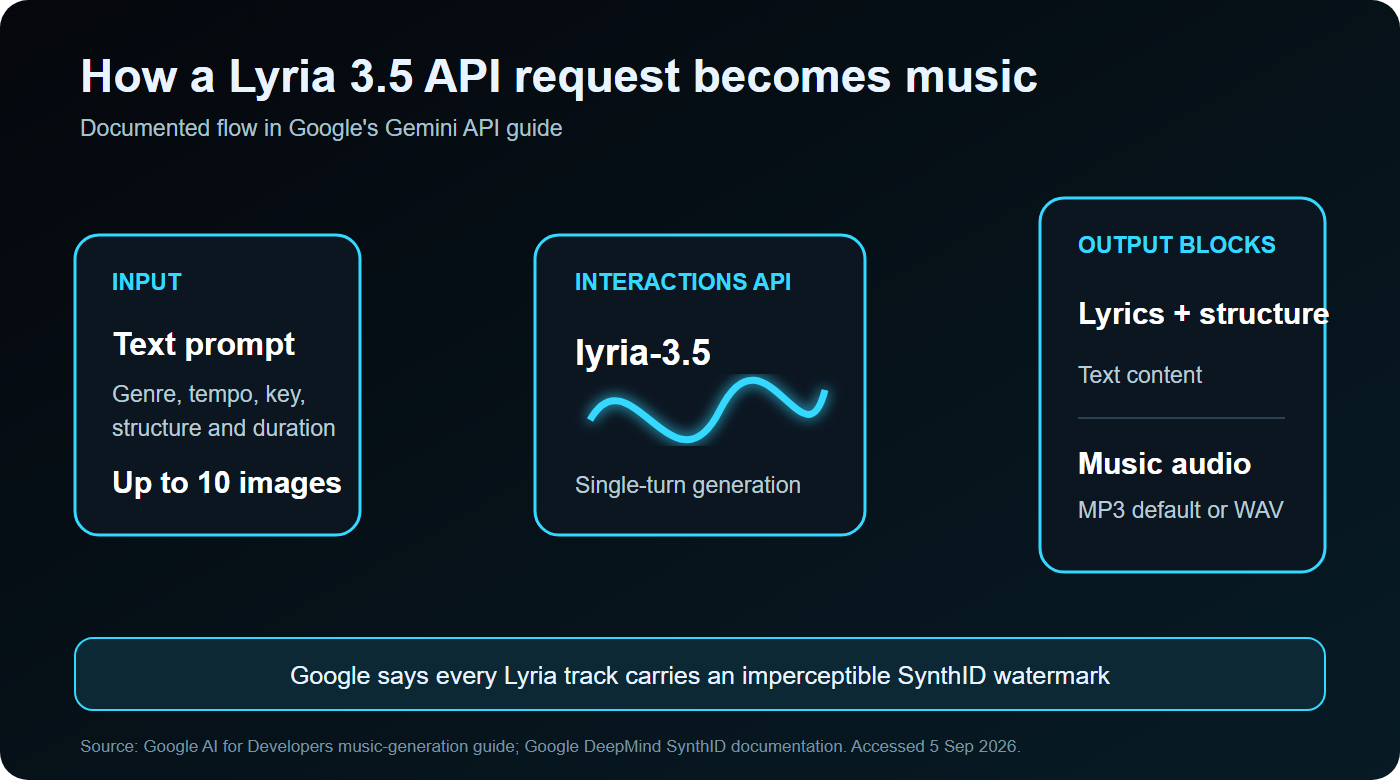
The response is split into steps. Text blocks can contain lyrics or a description of the song structure, while an audio block carries base64-encoded music. Convenience properties expose the last audio block and generated text for common cases; applications that need every interleaved block must walk the full step sequence. MP3 is the default. The guide also documents WAV output for Lyria 3.5.
That structure matters for products that need to display lyrics, save audio and retain a record of how the model organised the track. It also creates an integration constraint: the current release is single-turn. Google says developers cannot refine an existing generation through a multi-prompt editing conversation, and repeated calls with the same prompt may produce different results.
Access is broad, but the routes have different terms
Google describes Gemini app access as global on web and mobile. The help documentation adds account and age requirements, so "all users" does not mean anonymous or unrestricted use. In the API, Google lists Lyria 3.5 at $0.08 per full-song request on the paid tier and shows no free tier. Its model page labels lyria-3.5 as a preview and gives it a 131,072-token input limit. Batch, live, function-calling, search-grounding and structured-output features are listed as unsupported.
Every output also carries provenance. Google DeepMind says all Lyria tracks receive an imperceptible SynthID watermark. Its SynthID documentation says the audio marker is designed to survive common changes such as MP3 compression, added noise and speed adjustments. Users can ask Gemini to check uploaded audio for a Google AI watermark, while the separate SynthID Detector remains an early-access tool for selected testers.
Google's Lyria 3.5 model card describes dataset filtering, safety filtering, red-team testing and watermarking, but it does not publish training-data composition or resolve copyright questions for generated songs. The launch opens a practical route for music inside apps and workflows. It does not, by itself, establish how musicians, rights holders or platforms will treat those outputs.


Comments ()