
Microchip folds Hailo into its edge AI stack
Microchip completed its Hailo acquisition, giving its embedded-systems portfolio a dedicated edge AI and vision-processing layer.
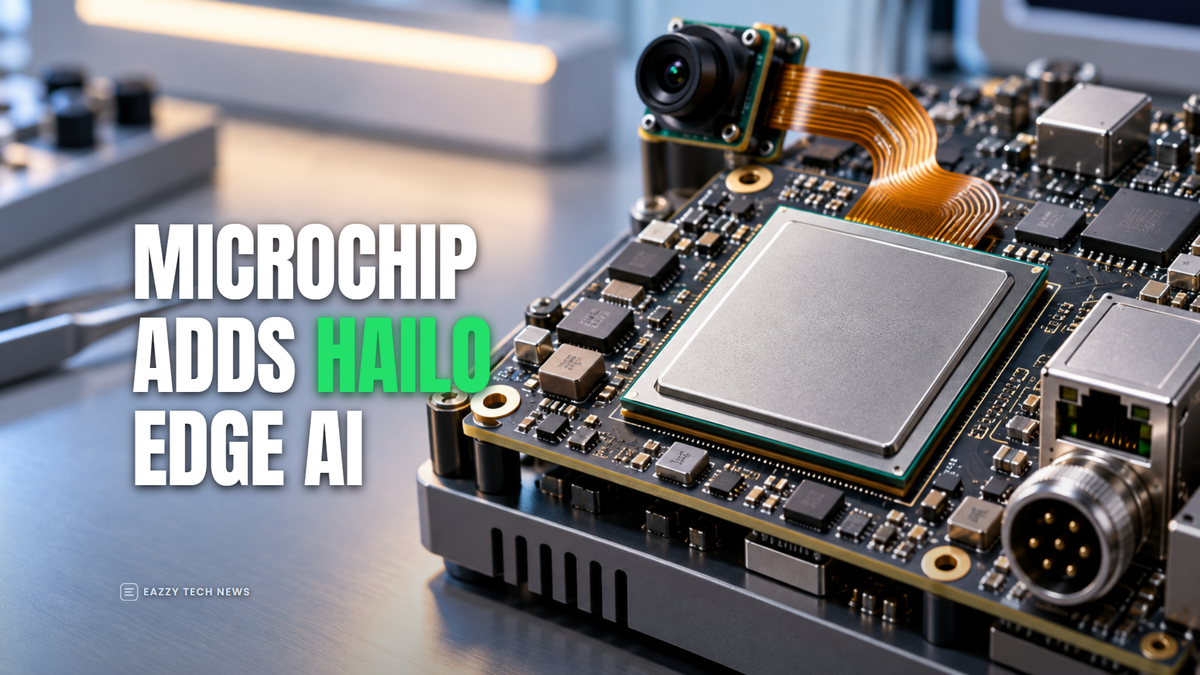
Microchip has completed its acquisition of Hailo, adding edge AI accelerators, vision processors, robotics processors and AI software to a semiconductor portfolio already built around embedded control, connectivity, security, analog and power components.
The company announced the closing on September 21, 2026, after first signing a definitive agreement on July 24. Microchip said the transaction terms were not disclosed and that the deal is not expected to have a material impact on its financial results. Investing.com, carrying Reuters-labelled coverage, reported the same closing and terms from the company statement.
The deal matters because edge AI hardware is becoming a system-integration problem. A smart camera, robot, drone or industrial gateway needs more than a neural-network accelerator. It needs sensors, memory, connectivity, device security, power management, long-term support and software that can survive production use. Microchip already sells many of those surrounding parts. Hailo brings the dedicated AI and vision pieces that sit closer to the model workload.
What Hailo adds
Hailo is best known for processors that run AI inference near the device instead of sending every video frame or sensor event to a cloud service. Microchip's Hailo product page now describes the acquired portfolio as AI accelerators, vision processors, software tools and development platforms. It lists Hailo-8 AI accelerators, Hailo-10 accelerators for large language model and vision-language model support, and Hailo-15 vision processors.
That mix gives Microchip three practical additions:
- AI acceleration: chips designed to run neural-network workloads locally, where latency, bandwidth or privacy constraints make a cloud round trip unattractive.
- Vision processing: processors and software for camera-based systems, including image signal processing, video handling and AI video stream analysis.
- Developer reach: Microchip said Hailo brings more than 100 customers and a developer community of more than 10,000 users.
The July signing announcement gave more detail about the product scope. Microchip said Hailo's portfolio supports classic computer vision, transformer-based models, multimodal workloads, image signal processing, DSP, H.264/H.265 encoding and AI video stream processing. Those are company claims, but they explain why Microchip is positioning the acquisition around intelligent edge systems rather than one chip family.
Why embedded buyers care
Microchip's pitch is not that every device becomes autonomous overnight. It is that more products now need enough local intelligence to make a fast decision before a cloud service answers. That can matter in a factory inspection line, a warehouse robot, a vehicle sensor, a smart camera or a drone that cannot depend on perfect network conditions.
Local AI does not remove the cloud from the design. Training, fleet analytics, heavy reasoning, telemetry and updates may still sit in larger infrastructure. The change is the boundary. More perception and filtering can happen on the device, while deeper analysis and management stay elsewhere.
That boundary is where Microchip has a reason to own more of the stack. Its existing embedded portfolio covers microcontrollers, FPGAs, connectivity, security, analog and power. Hailo adds processors and tools aimed at the AI workload itself. If the combined catalogue works as advertised, a customer building a camera, robot or industrial edge box can source more of the sensing, control and inference path from one supplier.
The limits are still important
The financial boundary is clear. Microchip has not disclosed the price, and it says the transaction is not expected to materially affect its financial results. That means the story is strategic rather than a near-term revenue reset.
The product boundary is also clear. Microchip's announcement says it plans to keep supporting Hailo's existing product portfolio, software environment and customer engagements while investing in future tools and technologies. That is a continuity promise, not proof that integration is finished. Customers will still care about roadmap clarity, software migration, supply availability, support channels and whether Hailo's existing ecosystem keeps moving at the same pace inside a larger semiconductor company.
Microchip's own July cautionary statement named integration and retention risks, including the ability to integrate operations and employees, retain key employees and customers, and realize expected benefits. Those risks did not disappear because the transaction closed. They are the next test.
What to watch next
The most useful follow-up will be product evidence rather than acquisition language. Buyers should watch whether Microchip publishes combined reference designs, development kits, supported software paths and clear migration guidance for Hailo customers. They should also watch whether Hailo's Raspberry Pi ecosystem, developer zone, GitHub activity and community forum remain visible channels for experimentation and support.
The closing gives Microchip a stronger edge-AI story on paper: control, connectivity, security, power and AI inference can now be sold as a more complete platform. The harder work starts after the press release. The company has to show that Hailo's acceleration and vision software can fit naturally into Microchip's embedded support model without slowing the developers and customers that made Hailo valuable in the first place.


Comments ()