NVIDIA's Jetson Orin Nano 2 puts the AI race inside 15 watts
Jetson Orin Nano 2 shows why edge AI is becoming a power, memory, latency and maintenance decision, not just a smaller version of cloud AI.
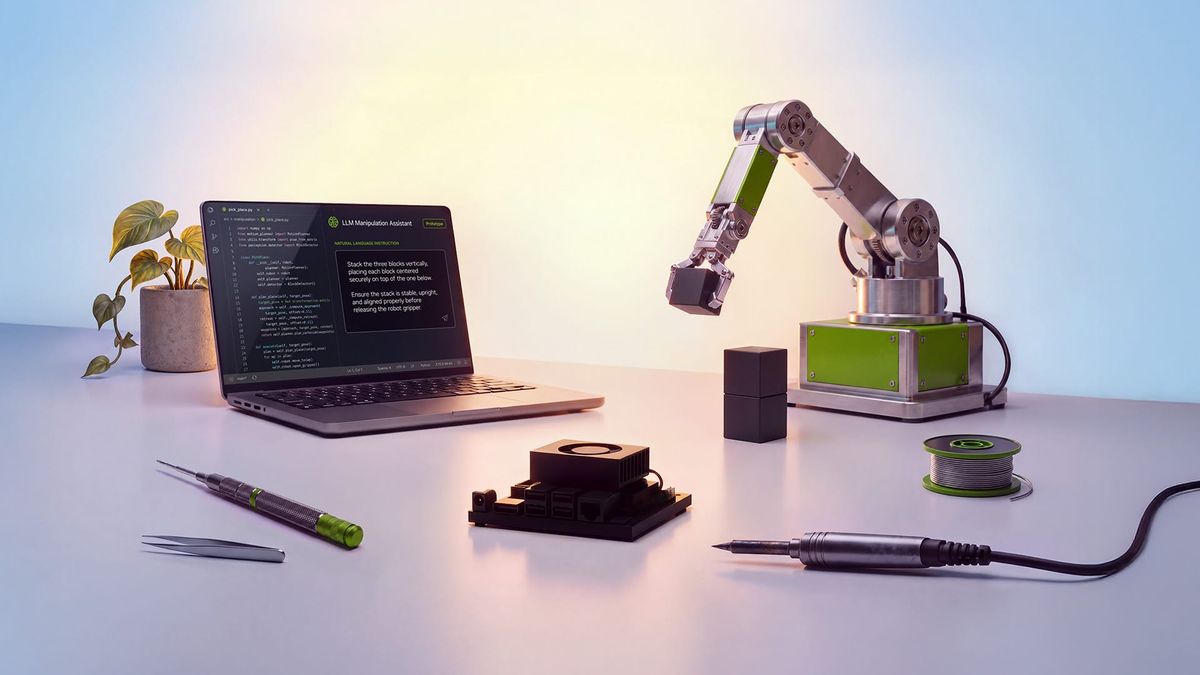
The August 25 module promises 78 TOPS, twice the inference performance of Jetson Orin Nano Super, and lower power at matched performance. The bigger story is where local AI is worth the engineering work.
NVIDIA's Jetson Orin Nano 2 is a small-board announcement with a useful constraint hidden inside it: the AI race is no longer only about giant data centers. It is also moving into devices that have to think inside a tight power and heat budget.
NVIDIA announced Jetson Orin Nano 2 on August 25, 2026, describing it as an entry-level robotics and edge-AI computer due in the first half of 2027. The company says the module has 78 trillion operations per second of AI compute, 8GB of memory and an 8-core Arm CPU. It also says the new board delivers twice the inference performance of Jetson Orin Nano Super in the same form factor, while using 40% less power at the same performance in 15-watt mode.
Those numbers are company claims, not independent lab results. They still point to the right question for edge AI: not whether a small device can run a model, but whether it can run the right model fast enough, locally enough and reliably enough to improve the product.
Cloud AI is not disappearing. The cloud will still train larger models, host heavy reasoning, hold fleet telemetry and coordinate updates. But more cameras, drones, robots, factory gateways and inspection systems now need enough intelligence on the machine to react before a round trip to a data center makes the answer late, costly or unavailable.
Edge AI is a watt problem
The easiest spec to quote is TOPS, short for tera operations per second. It is also one of the easiest specs to overread. A chip can advertise a large operations number and still fail the product if it drains the battery, overheats the enclosure, starves memory, loses sensor data, or needs a software stack the team cannot maintain.
That is why the 15-watt comparison matters. NVIDIA says Jetson Orin Nano 2 can hit the same performance as its predecessor while using 40% less power in that mode. For a drone, a mobile robot, a smart camera or a kiosk, that can be more useful than a peak number reached under conditions the product cannot sustain.
The earlier Jetson Orin Nano Super developer kit already framed the trade-off. NVIDIA's user guide lists up to 67 INT8 TOPS, up to 102 GB/s of memory bandwidth and a configurable 7W to 25W power range for edge AI and generative AI workloads. In other words, the board is not one fixed computer. It is a set of operating points that developers have to choose between.
NVIDIA's JetPack 6.2 Super Mode post makes the same lesson plain. Super Mode raises clocks and adds new power modes, but NVIDIA warns that an uncapped mode can throttle when module power exceeds the thermal design budget. Its language is careful: developers should build custom power modes for their own balance of performance and thermal stability.
That is the practical edge-AI problem in one sentence. Local intelligence is useful only when the board, enclosure, model and workload can live together for the whole duty cycle, not only for a benchmark run.
Why the cloud still stays in the design
Edge computing exists because distance has a cost. ETSI's Multi-access Edge Computing group describes edge environments in terms of low latency, high bandwidth and access to real-time network information near the user or device. The same principle applies beyond telecom networks. A warehouse camera, a hospital device, a field robot or an inspection drone may need to interpret sensor data close to the event.
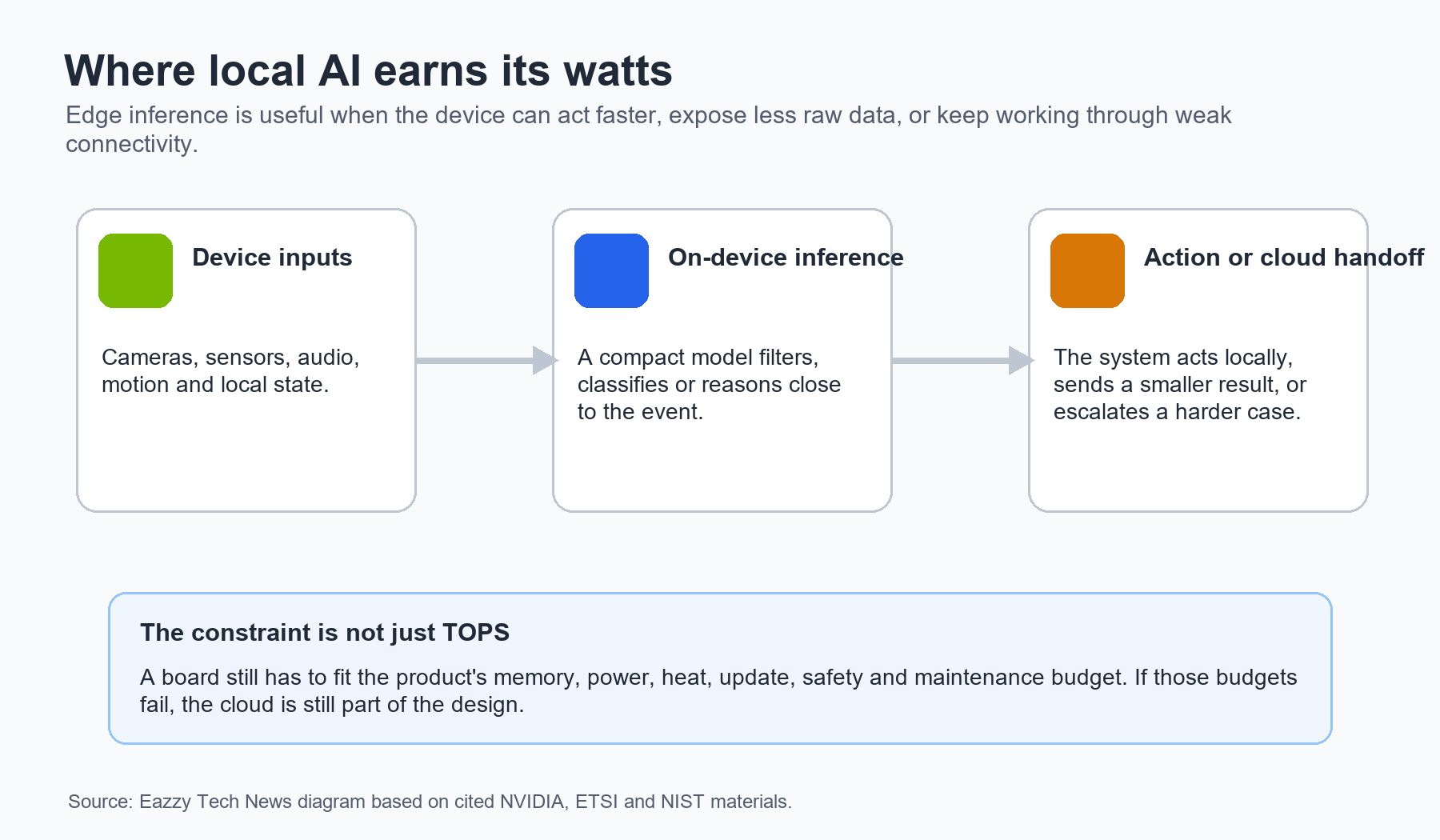
Local processing can reduce the amount of raw data sent across a network. It can help a system keep working when connectivity is weak. It can also reduce the delay between perception and action. Those are solid reasons to move some inference closer to the sensor.
Privacy is more complicated. NIST research on edge systems notes that moving IoT processing from cloud systems to edge devices can bring networking benefits, but it also creates privacy concerns around continuous sensor streams. The location of compute does not solve governance by itself. A device that analyzes video locally may expose less raw footage, but it still needs clear data retention, access control, audit and update rules.
That is why edge AI should not be sold as cloud replacement. It is a cloud split. Fast perception, local filtering and immediate control move closer to the device. Model training, heavier analysis, long-term storage, fleet comparison and software distribution usually stay in larger infrastructure. The hard product work is deciding which side handles each task.
The small-board market is getting crowded
Jetson Orin Nano 2 is not arriving in an empty category. Developers already have boards and modules aimed at edge vision, industrial IoT, robotics and local inference. The choices are not interchangeable, because each one favors a different mix of compute, software, sensors, operating systems and production integration.
| Hardware | Public compute figure | Developer angle | Limit to keep in view |
|---|---|---|---|
| NVIDIA Jetson Orin Nano 2 | 78 TOPS, according to NVIDIA | Entry-level robotics, drones, vision AI and compact generative-AI inference | Expected in H1 2027; public figures are vendor claims |
| NVIDIA Jetson Orin Nano series | Up to 67 TOPS in the current lineup | Small Jetson form factor with JetPack, CUDA, TensorRT and robotics tooling | Power, thermals and memory decide usable sustained performance |
| Qualcomm Dragonwing RB3 Gen 2 dev kit | Up to 12 dense TOPS, according to Qualcomm | IoT edge AI with Linux, Android, Ubuntu, Windows, cameras and wireless support | Lower published compute figure, but a broader connectivity and OS pitch |
| Raspberry Pi AI HAT+ | 13 TOPS or 26 TOPS, depending on the Hailo accelerator | Low-cost Raspberry Pi 5 add-on for camera-based inference | Requires a Raspberry Pi 5 host and compiled accelerator workflows |
| Hailo-8 M.2 module | Up to 26 TOPS, according to Hailo | M.2 accelerator for adding local inference to existing edge devices | Best fit is neural-network inference, not general local computing |
The table shows why Jetson's place is specific. Raspberry Pi plus Hailo is attractive for low-cost camera projects. Hailo modules are narrow accelerators that can slot into existing hardware. Qualcomm's pitch includes connectivity, operating-system choice and multimedia pipelines. Jetson has a stronger claim when a developer wants NVIDIA's software stack, GPU programmability, robotics tooling and enough local compute for vision-language models or compact language models.
That software story matters because edge AI is not only a board purchase. Models need to be selected, quantized, compiled, tested against sensor inputs, monitored for drift and updated without breaking the device in the field. The small computer is just the most visible part of the system.
Small models change the edge, but not all at once
NVIDIA's announcement says small and medium models have improved enough to make more edge devices capable of understanding context, images and language locally. The company names NVIDIA Cosmos, NVIDIA Nemotron, Gemma 4 and Qwen 3 as examples of models developers can run after optimization for memory-efficient edge inference.
The safer reading is narrower than the marketing. Edge devices can now handle more useful local AI tasks than they could a few years ago, especially when models are quantized and designed for a specific job. That does not mean every device should run a general assistant, or that an 8GB module can replace a cloud cluster for heavy reasoning.
Memory remains a hard limit. The current Jetson Orin Nano Super documentation lists 8GB of LPDDR5 memory and 102 GB/s of memory bandwidth. Jetson Orin Nano 2 raises NVIDIA's published compute figure to 78 TOPS, but the announcement still describes an 8GB memory configuration. That shapes the kinds of models and workloads that fit. A small model that classifies images, reasons over a short command, tracks objects, or filters video may be practical. A large context-heavy model with broad tool use is more likely to need a nearby server or cloud handoff.
The useful pattern is not "put the whole AI stack on the device." It is "put enough inference near the event to avoid unnecessary delay, bandwidth, privacy exposure or downtime." A machine can detect a hazard locally, send a smaller alert to the cloud, and leave deeper review for a larger system. A drone can keep perception onboard while fleet analytics and model updates happen elsewhere. A home robot can process some spatial and interaction data locally while still receiving software updates from the vendor.
Partner claims show the target market
NVIDIA says Cognex, Doosan Bobcat and Matic are among the first companies adopting or exploring Jetson Orin Nano 2. It also says Wing, Alphabet's drone delivery subsidiary, uses Jetson Orin Nano Super and the NVIDIA software stack in its delivery drone fleet, and plans to evaluate the new board.
Those statements should be read as partner and vendor claims. They are still revealing. The examples cluster around machines that see, move or operate near people: industrial vision systems, equipment, home robots and delivery drones. These are not abstract chatbot use cases. They are machines where milliseconds, energy draw, sensor fusion and local failover matter.
Drones make the trade-off especially visible. A drone has limited onboard power and weight capacity. It also cannot depend on perfect connectivity for every perception decision. If a board can deliver similar inference at lower power, that may leave more room in the overall system budget for sensors, communications, safety margins or flight time. NVIDIA and Wing have not claimed Jetson Orin Nano 2 will increase range or endurance. The point is more cautious: power saved by compute can become design room elsewhere, if the whole aircraft supports it.
Home robots have a different constraint. They operate around private spaces, changing layouts and people who do not want every raw sensor stream sent away by default. Local inference can help with privacy and responsiveness, but it also raises maintenance demands. A robot in a home must receive updates safely, explain failures clearly enough for users to recover, and avoid turning a model error into a physical problem.
Industrial vision sits between those examples. A smart camera or inspection gateway may not need broad language capability at all. It may need stable object detection, defect classification, line-speed processing and a clean integration path into factory systems. For that buyer, the best board is the one that survives heat, dust, network changes, model updates and production uptime requirements. A headline TOPS number gets attention. Integration decides whether it ships.
What builders should test first
Jetson Orin Nano 2 will be most interesting to teams that already know why inference must move closer to the device. For everyone else, the right starting point is not the hardware catalog. It is the workload.
Before designing around any edge-AI board, teams should test:
- Latency budget: how fast the system must sense, infer and act before the answer becomes stale.
- Power and thermals: whether the device can sustain the required workload in its real enclosure, ambient temperature and duty cycle.
- Memory fit: whether the model, sensor buffers, runtime and operating system fit without constant swapping or aggressive compromises.
- Sensor path: whether cameras, microphones, lidar, radar or industrial inputs can move data into the model without losing timing or quality.
- Update path: how models, drivers, firmware and safety rules will be rolled back when an update fails.
- Cloud boundary: which data leaves the device, which decisions stay local, and which hard cases escalate.
Those checks sound ordinary, but they decide the product. A prototype that runs a demo model on a desk has not proved that it can run in a warehouse, a yard, a vehicle or a home. A camera model that works on clean test footage has not proved that it can handle glare, dust, vibration, night conditions or a partially blocked lens. A language interface that works in a booth has not proved that it can safely control a moving machine.
This is where NVIDIA's ecosystem gives it leverage. Developers are not only buying a module. They are buying into JetPack, TensorRT, CUDA, Isaac-related robotics tooling, example workflows and a partner base. That can reduce engineering time for teams already familiar with NVIDIA's stack. It can also deepen lock-in if the model, deployment pipeline or hardware design becomes tied to NVIDIA-specific assumptions.
The same caution applies to every vendor. Qualcomm's operating-system and connectivity story may fit some IoT products better. Raspberry Pi and Hailo may fit education, maker and low-cost camera deployments. Hailo's M.2 modules may fit companies adding inference to hardware they already ship. The edge is not one market. It is a series of narrow power, software and sensor decisions.
The next AI computer may be invisible
The loudest AI infrastructure story is still about hyperscale data centers, GPU allocations, memory supply and power contracts. That story is real. It is also incomplete. AI is spreading into smaller machines because many decisions are useful only when they happen near the event.
Jetson Orin Nano 2 makes that shift easier to see. NVIDIA is not claiming a finished world of autonomous devices. It is saying more local inference can fit into the entry-level edge category, with better performance and lower matched-performance power than the prior Jetson Orin Nano Super. The claim still has to meet real product testing when the module arrives in 2027.
The practical consequence is already clear. The edge-AI buyer now has to think like a systems designer. A small board has to fit the model, the sensors, the enclosure, the battery or power supply, the heat path, the update channel, the cloud boundary and the human recovery path. Miss one of those, and the AI feature becomes fragile.
The next useful AI computer may not look like a data center or a laptop. It may be a small module inside a camera, drone, robot or industrial box, doing one local job well enough that the cloud no longer has to answer every question.

Comments ()