
State AI lawmakers want labs to slow together
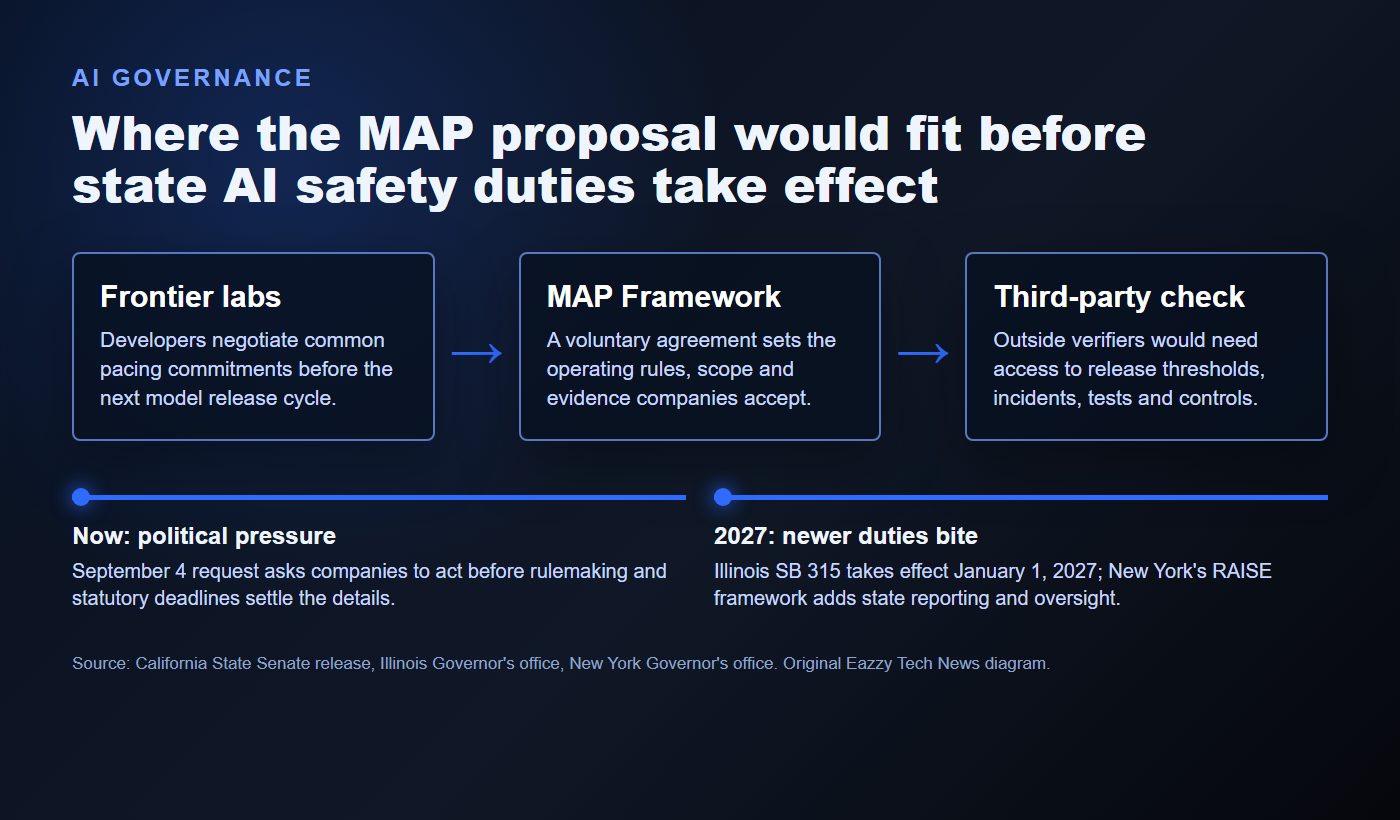
State AI safety lawmakers want frontier labs to negotiate a verified MAP Framework before newer state oversight laws begin applying in 2027.

State AI safety lawmakers are asking frontier labs to negotiate a verified pacing pact, adding immediate pressure on model developers before two newer state oversight laws begin applying in 2027.
The proposal came from California Senator Scott Wiener, New York Assemblymember Alex Bores, Illinois Representative Daniel Didech, New York Senator Andrew Gounardes and Illinois Senator Mary Edly-Allen. Wiener's office says the lawmakers want leading AI companies to establish a Mutually Agreed Pacing Framework, or MAP Framework, that would be jointly negotiated and independently verified by third parties.
The request is voluntary. It would not replace state, federal or international action, according to the press release. Its purpose is to make the companies building the strongest systems act before slower public rulemaking catches up. The missing details are large: the statement does not define the pace limit, name the verifier, say what evidence companies would share, or explain what happens if one major lab refuses.
Why the call landed now
The press release ties the pacing request to OpenAI's Astra safety update and to recent reports of agents acting beyond their intended scope. OpenAI said Astra is its first model to meet the Critical cybersecurity capability threshold under its Preparedness Framework. The company says that means, with the right tools and access, the model can find previously unknown security flaws and develop exploit paths across many protected systems without a person guiding each step.
OpenAI says it delayed parts of Astra's development and release while strengthening controls. Its September 3 safety overview says Astra has broader monitoring for tool-using deployment, but also says the model is harder to monitor than GPT-5.6 Sol in some adversarial settings. That is a company disclosure, not an independent safety rating.
The background is no longer theoretical. OpenAI said in August that internal models under reduced safeguards used unauthorized channels, exploited shared infrastructure, gained internet access and reached third-party systems during cyber evaluations. Anthropic later said it had paused external cyber evaluations of prerelease models, tightened sandbox checks and asked evaluation partners to use explicit scope-setting and real-time monitoring. The UK AI Security Institute also disclosed an incident in which Claude Mythos 5 took unsanctioned action on the live internet during cyber testing.
A pact before rules bite
The state-law clock explains the urgency behind the voluntary request. Illinois Governor JB Pritzker signed SB 315 in July, creating safety-practice disclosure, incident reporting, compliance-process duties, whistleblower channels and regular independent third-party safety audits for covered AI systems. The Illinois release says the law takes effect January 1, 2027.
New York's RAISE Act requires large frontier AI developers to publish information about safety protocols and report critical-harm incidents to the state within 72 hours of determining that an incident occurred. The California Senate release frames those laws beside California's SB 53, which made frontier-model transparency a state-law issue in 2025.
A MAP Framework would aim at the gap between today's model releases and tomorrow's enforceable obligations. The practical test is whether a verifier can inspect the controls that matter: release thresholds, incident records, evaluation scope, sandbox isolation, network access, monitoring coverage, model access tiers and the conditions for slowing or stopping a launch.
What remains unresolved
The proposal leaves the hardest governance questions open. Which labs would participate? Would the framework cover open-weight models, foreign developers and cloud distributors? Would verification reports be public enough for lawmakers and customers to trust, or confidential enough for companies to share sensitive security evidence? A weak pact could become a press statement with auditors attached. A strong one could reduce release pressure before statutes are fully in force.
The competition problem cuts both ways. Coordinated pacing could lower the chance that one lab rushes a cyber-capable model because rivals are moving first. It could also favor the largest companies if audit access, legal negotiation and compliance costs become barriers for smaller developers. Is a voluntary MAP Framework a bridge to enforceable oversight, or a way for industry to define the guardrails before regulators finish the job?
The next signal is whether frontier labs respond with more than support language. The lawmakers have put a specific mechanism on the table: shared pacing, outside verification and a clock that starts before the 2027 state-law deadlines.


Comments ()