
Amazon's touch robot shows why physical AI starts in the warehouse
Amazon's warehouse robots show the practical route for physical AI: controlled spaces, rich operational data, narrow tasks, and clear human handoffs.
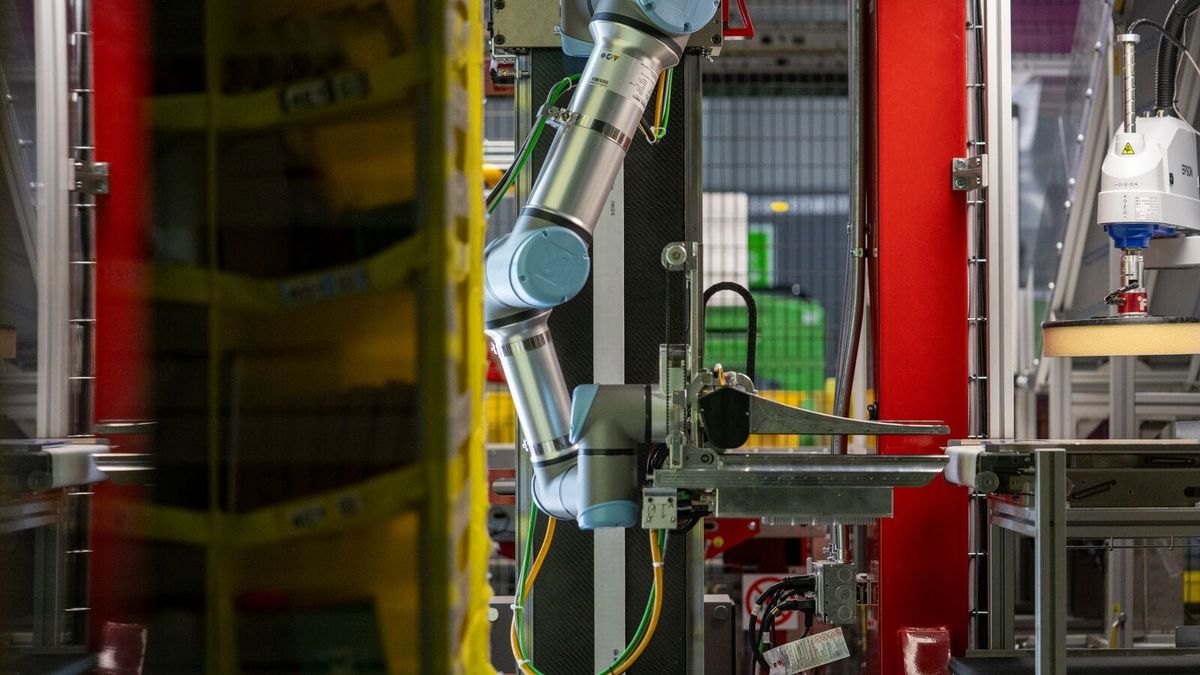
Subtitle: Vulcan can feel crowded inventory bins, Proteus is getting plain-language tasking, and DeepFleet coordinates robot traffic. Together they show why useful robots arrive first in constrained workflows.
Amazon's latest warehouse robotics push is easy to misread if the only thing you look for is a new machine with a memorable name. The more important pattern is the way the company is splitting physical AI into narrow jobs: touch for crowded bins, language for task assignment, and fleet learning for traffic on the warehouse floor.
In June 2026, Amazon said its next-generation Proteus robot would let employees assign some movement tasks with plain-language prompts, while Vulcan and STARK would expand to more European sites as part of a more than EUR10 billion fulfillment-center modernization plan. Proteus is still in lab pilots, with deployment in Europe planned for the first half of 2027. Vulcan is further along: Amazon says the touch-sensing system already works in Spokane, Washington, and Hamburg, Germany, handling difficult high and low inventory positions that usually force employees onto ladders or into awkward reaches.
The useful lesson is not that warehouses are about to run themselves. Amazon does not claim that. The lesson is narrower and more practical. Physical AI is becoming useful where the environment can be instrumented, the task can be bounded, failures can be handed to people, and the operator has enough data to keep improving the system.
The constrained robot is the useful robot
General-purpose robots sound more exciting than warehouse automation. They also hide the hard part. A robot in the physical world must perceive objects, plan motion, apply force, avoid people, recover from mistakes, and keep doing all of that under speed, safety, cost, and maintenance constraints. Language alone does not solve those problems.
Amazon's warehouse systems show a more credible route. They make the problem smaller without making it trivial. Vulcan does not need to clean a kitchen, fold laundry, or repair a machine. It needs to pick and stow items inside fabric-covered inventory compartments about a foot square, where Amazon says each compartment holds up to 10 items on average. That is still hard. Items slide, bend, block one another, reflect light differently, and change packaging over time. But the robot works in a known building, against known inventory systems, with known handoff rules.
That is where touch matters. In its Vulcan announcement, Amazon describes an end-of-arm tool with force feedback sensors that tell the robot how hard it is pushing or gripping. For picking, Vulcan uses a camera and suction cup to identify the target item and avoid pulling out the wrong object with it. For stowing, a paddle-like mechanism moves nearby items aside, adjusts grip strength, and feeds a new item into the compartment.
Amazon says Vulcan can pick and stow about 75% of item types stored in its fulfillment centers, at speeds comparable to front-line employees. That is a company claim, not an independently audited benchmark. It is still useful because of what it reveals about the shape of the problem. A robot can be commercially meaningful without handling everything. The unsolved 25% matters, but it can be routed to people if the workflow is designed for that handoff.
Touch is not a feature. It is a failure-control system
Robotic picking has long leaned on vision: find the object, estimate a grasp point, move the arm, and hope the suction cup or gripper does not disturb the rest of the bin. That works better for cleanly separated packages than for cluttered retail inventory. A vision-only robot can see contact after it happens, but it may not know how much force it applied or whether it is about to damage the item, the bin, or the objects around it.
Vulcan's tactile feedback changes that control loop. The robot gets information at the point of contact, not only from the camera above the scene. That matters in the same way a human hand matters when pulling a book from a packed shelf. You do not only look. You feel resistance, adjust pressure, and stop before the motion becomes destructive.
Amazon frames this as an ergonomics gain because Vulcan targets high and low rows in storage pods. That claim fits the physical setup: top rows can be about eight feet high, while low rows require crouching. If the robot handles those positions and people spend more time working at mid-body height, the motion burden changes. Whether that translates into better injury outcomes depends on broader site pacing, staffing, measurement, and safety practices, not on the robot alone.
The stronger technical claim is simpler: touch gives the machine a way to notice contact before contact becomes a failure. That is physical AI in a practical form. It is not a chatbot with an arm. It is sensing, control, and escalation wrapped around a specific industrial job.
The warehouse is also the training set
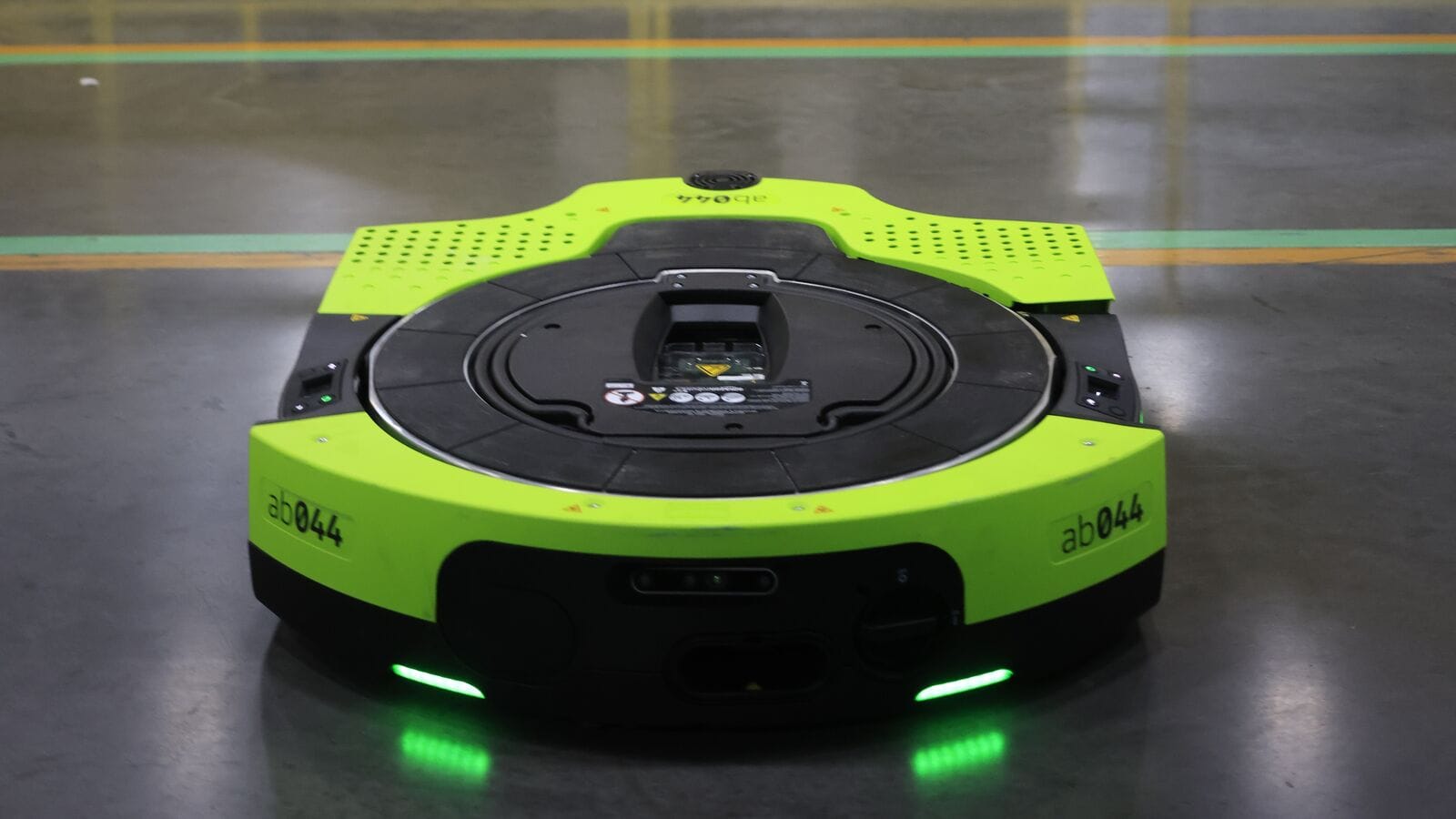
The same pattern appears in Amazon's fleet software. In June 2025, Amazon said it had deployed its one millionth robot across more than 300 facilities and introduced DeepFleet, a foundation model intended to improve robot fleet travel time by 10%. That number is also Amazon's claim. The company has a reason to present the system in the best light. But the engineering explanation is worth paying attention to.
In an Amazon Science article, the DeepFleet team describes the model as a way to predict future traffic patterns for fleets of mobile robots using large volumes of movement data from fulfillment centers and sortation centers. The company says simulation alone is not enough because accurately simulating the interactions of thousands of robots faster than real time is expensive. A learned model can infer likely congestion and support routing or assignment decisions faster.
The DeepFleet paper frames the system as a suite of multi-agent foundation models trained on robot positions, goals, interactions, and warehouse-floor structure. The team tested several architectures, including robot-centric, robot-floor, image-floor, and graph-floor approaches. Amazon Science says the robot-centric model performed best on some prediction measures, while the robot-floor model did best on timing estimation and the graph-floor model delivered strong results with fewer parameters. The image-floor approach was weaker, which the authors attribute to a mismatch between convolutional image methods and pixel-level floor-state prediction.
That is not a glossy story about an all-knowing robot brain. It is a specific prediction problem with messy architecture trade-offs. It also explains why logistics operators have an advantage in physical AI. They own the buildings, the work sequences, the sensors, the robot logs, and the outcome data. The warehouse does not merely host the robot. It teaches it.
| System | Confirmed status | Robotics problem | Important limit |
|---|---|---|---|
| Vulcan | Amazon says it operates in Spokane and Hamburg | Picking and stowing cluttered inventory with force feedback | Amazon says it handles about 75% of item types, not all items |
| Proteus, next generation | Amazon says it is in lab pilots, with Europe planned for H1 2027 | Moving carts and containers through more areas with plain-language tasking | Deployment timing and operating scope remain company plans |
| STARK | Amazon says it was first piloted in Barcelona and is planned for 15 European sites by 2027 | Moving full totes from conveyors to carts | Public details focus on rollout plans, not independent performance data |
| DeepFleet | Amazon says it improves robot travel time by 10% | Predicting and reducing mobile-robot traffic congestion | The performance figure is a company-reported operational claim |
Foundation models for robots are still local before they are general
Amazon is not alone in trying to move robot learning beyond single-purpose scripts. Covariant introduced RFM-1 in March 2024 as an 8 billion-parameter robotics foundation model trained on text, images, video, robot actions, and physical measurements. Covariant said its earlier systems had operated across warehouse customers in 15 countries and four continents. That is a commercial claim from the company, but it points to the same constraint: the most mature examples begin in warehouses, where large amounts of repeated physical interaction data can be collected.
Toyota Research Institute's Large Behavior Model work makes the research limit even clearer. TRI says its LBM study trained diffusion-based models on almost 1,700 hours of robot data, then ran 1,800 real-world evaluation rollouts and more than 47,000 simulation rollouts. The reported result was not instant general intelligence. TRI found that pretraining improved performance, helped new tasks with 3-5 times less data in challenging settings, and improved as pretraining data increased. That is progress, but it is still progress measured through carefully defined tasks.
Boston Dynamics and TRI are applying similar ideas to Atlas. In August 2025, Boston Dynamics said its Atlas LBM work uses end-to-end language-conditioned policies for long-horizon manipulation, taking images, proprioception, and language prompts as inputs and outputting full-robot actions at 30 Hz. The work builds on a collaboration that Toyota and Boston Dynamics announced in 2024.
Those systems are important because they test harder forms of embodiment: balance, whole-body motion, dexterous manipulation, and recovery from surprises. They are also a reminder that the path from a lab demonstration to a durable customer deployment is long. A warehouse arm that can reject difficult items may be less glamorous than a humanoid doing a chore sequence, but it is easier to measure, easier to maintain, and easier to put inside a business process.
The worker story needs more than company framing
Amazon consistently describes its robots as tools for safety, ergonomics, and better jobs. Its June 2026 European robotics announcement says the investment includes 25,000 planned fulfillment-center jobs in Europe over the coming years. Its one-million-robot announcement says more than 700,000 employees have been upskilled through training initiatives. A March 2026 safety update says Amazon has reduced its global recordable incident rate by 43% since 2019 and invested more than $2.5 billion in safety since that year.
Those claims should sit beside the dispute over Amazon's warehouse safety record. In December 2024, AP reported that a U.S. Senate committee report alleged Amazon rejected or altered internal safety recommendations because of productivity concerns. Amazon disputed the findings, and in its own response to the Senate report, the company argued that the report's injury-productivity premise was flawed and said its delivery speeds had increased while injury rates had decreased.
Robots can reduce some dangerous motions and introduce new pressures at the same time. A system that removes ladder work is not the same as a system that lowers total injury risk across a site. A routing model that reduces congestion can improve flow, but the business may use that efficiency to change staffing targets, throughput expectations, or shift design. Those are operational choices, not automatic outcomes of the robot.
That is why the worker impact should be judged through injury records, pace expectations, maintenance staffing, training access, and employee control over exceptions. If Amazon's systems do reduce heavy lifting while creating skilled maintenance roles, that should show up in more than press language. If they mainly raise throughput pressure, that will show up too.
What other robotics buyers should copy
The Amazon example is most useful when stripped of Amazon's scale. Few companies have a million deployed robots, hundreds of facilities, or the ability to design hardware, software, warehouse layouts, training programs, and cloud infrastructure as one system. That does not make the lesson irrelevant. It makes the lesson more disciplined.
Companies looking at physical AI should copy the constraint, not the size. The best first deployment is usually a task with a clear object class, a defined space, existing process data, a measurable failure mode, and a human fallback. The robot should change a workflow that already exists, not depend on a fantasy workflow that only works in a demo video.
That favors industrial and logistics use cases such as tote handling, line feeding, inventory movement, pallet inspection, parcel sorting, machine tending, cleaning in mapped facilities, and agricultural field tasks with bounded crop and terrain conditions. It does not mean humanoids are useless. It means the buyer should know whether the humanoid shape solves a real constraint or mainly makes a demo easier to understand.
The same rule applies to AI models inside robots. A foundation model can help when the task produces enough data and the deployment has a feedback loop. DeepFleet makes sense because mobile-robot traffic produces constant state data. Vulcan makes sense because contact-rich picking produces repeated examples of success, failure, and human escalation. A model without that loop becomes expensive guesswork.
The next milestone is boring on purpose
The next stage of physical AI will not be defined by one robot suddenly doing every job. It will come through narrow systems that keep absorbing more edge cases: a picker that handles more awkward packages, a mobile robot that works in more parts of a building, a fleet model that reduces congestion under more conditions, and a human handoff that becomes less frequent because the robot has seen similar failures before.
Amazon's warehouse stack is useful because it makes that progression visible. Touch sensing gives the robot better contact information. DeepFleet gives the fleet a better prediction layer. Plain-language tasking may make robot assignment easier for operations staff, provided the system keeps its action space bounded and auditable. None of that removes people from the story. It changes where people intervene.
Physical AI starts in the warehouse because warehouses are structured enough for robots to learn and messy enough for the learning to matter. That is a more grounded signal than another broad promise about general-purpose machines. The useful robot does not need to look like a person. It needs to know when it has touched the thing it was supposed to move, when it should stop, and when a human should take over.
Comments ()