
Australia's B300 order starts with hardware, not capacity
SuperX's 128-unit B300 order for Ezisight is a fresh signal that Australia wants more local AI compute. The harder question is what has to line up before ordered servers become usable domestic capacity.
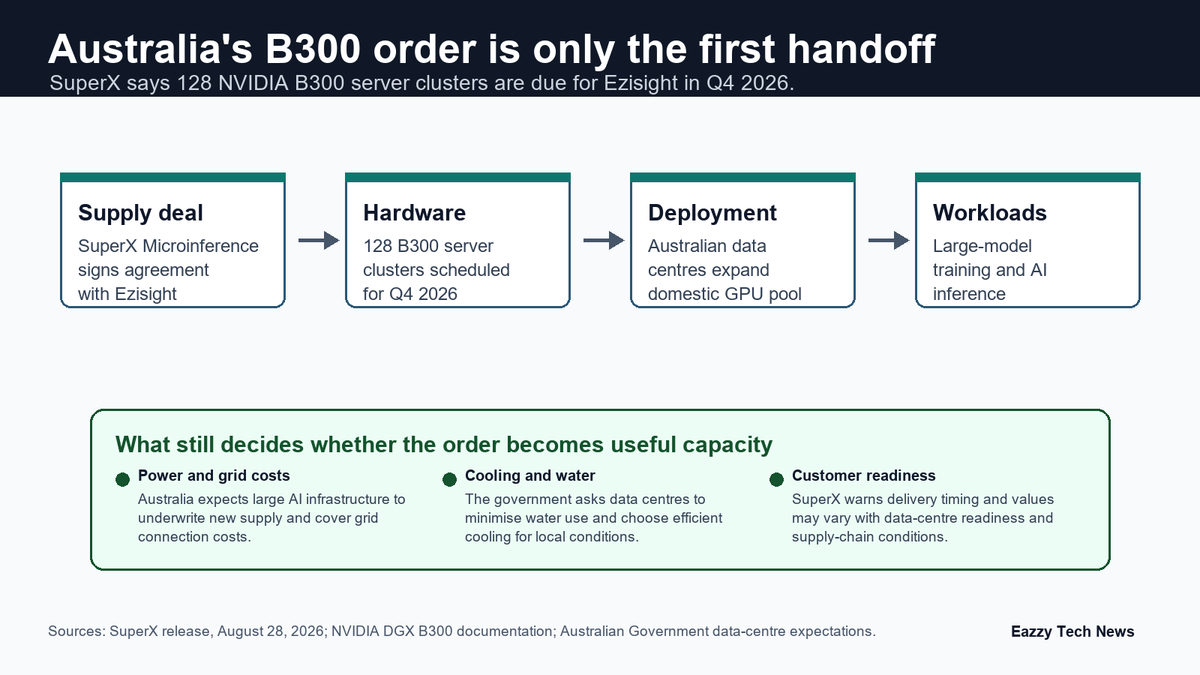
SuperX says an Australian compute provider has ordered 128 NVIDIA B300 AI server clusters, a fresh sign that the regional AI infrastructure race is moving from headline campus deals into server-level procurement.
The Singapore-headquartered company said on August 28, 2026 that its subsidiary SuperX Microinference had signed an equipment and services supply agreement with Ezisight Australia, which trades as Ultimate AI Datacentre. SuperX's own investor-relations release says the order covers 128 units of NVIDIA B300 AI server clusters, scheduled for delivery in the fourth quarter of 2026 and intended for local Australian data centres.
That is not the same as saying Australia suddenly has 128 new clusters running today. The useful reading is narrower and more important. A buyer has placed an initial order for a current-generation AI server class, and the supplier says those systems are supposed to expand Ezisight's domestic GPU compute pool for large-model training and inference. Whether that becomes useful capacity depends on delivery, site readiness, power, cooling, networking, operations and customers willing to run workloads locally.
The distinction matters because AI infrastructure is often announced in gigawatts, billions of dollars or national ambition. This deal is smaller in public detail but easier to interrogate. It names a server class, a unit count, a buyer, a market and a delivery window. It also arrives as Australia tries to attract AI data-centre investment while telling large operators that new capacity should not push costs onto households, businesses, water systems or the grid.
The order is real, but the capacity is planned
SuperX's release says the initial purchase order sits under a longer equipment and services agreement. It also says the B300 servers are scheduled for Q4 2026 delivery and will be deployed in Australian data centres to support local training and inference workloads. Those are company statements about an agreed order and an intended deployment path.
The caution is in the same release. SuperX warns that forward-looking events may not occur and that actual delivery timelines and values for AI servers may vary based on customer data-centre readiness and supply-chain conditions. That caveat is not boilerplate to skip over. For AI infrastructure, readiness is the work.
A GPU server cluster needs the chips, but it also needs enough power at the right voltage, cooling capacity, rack and floor design, network fabric, storage, security controls, operations staff, scheduling software and a commercial model that keeps the machines busy. Idle GPUs are not sovereign compute. Delayed GPUs are not local capacity. A cluster sitting in a building that cannot power or cool it is expensive inventory.
SuperX describes itself as a provider of hardware, software and services for AI data centres, including high-performance AI servers, 800 Volts Direct Current systems and high-density liquid cooling. That broader product list explains why a server order should be read as part of the facility stack, not as a box shipment story. The GPU is the most visible component. The deployment system around it decides whether customers can actually use it.
Why B300-class systems are attractive
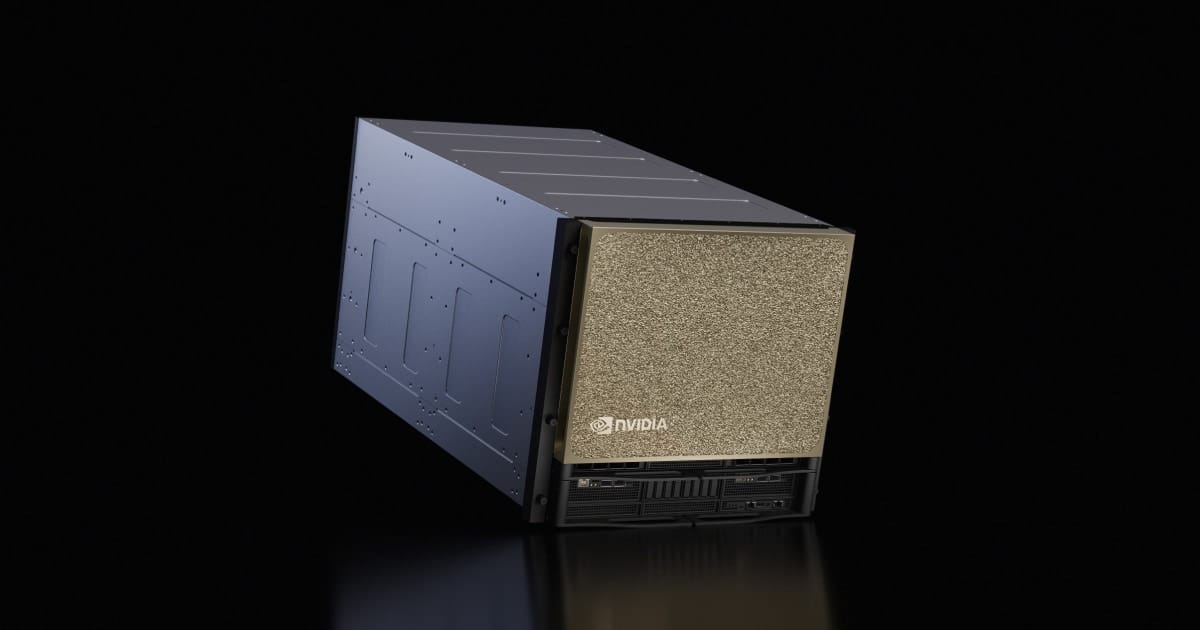
NVIDIA's own DGX B300 page says DGX B300 systems are shipping now and lists the system as eight Blackwell Ultra SXM GPUs, Intel Xeon 6776P processors, 2.1 TB of total GPU memory, 14.4 TB/s aggregate NVLink bandwidth, up to 800 Gb/s InfiniBand or Ethernet networking and about 14 kW of power consumption. NVIDIA's DGX B300 user guide gives the same basic shape from the technical side: eight B300 Blackwell Ultra GPUs, 288 GB of memory per GPU, 72 PFLOPS of FP8 training performance and 144 PFLOPS of FP4 inference performance.
| Item | NVIDIA DGX B300 reference figure | Why it matters for local compute |
|---|---|---|
| GPU count | 8 Blackwell Ultra GPUs per DGX B300 system | Useful for dense training, fine-tuning and inference nodes. |
| GPU memory | 2.1 TB total on the product page; 8 x 288 GB in the user guide | Large memory pools help with bigger models and longer contexts. |
| Networking | ConnectX-8 with up to 800 Gb/s InfiniBand or Ethernet | Cluster performance depends on moving data between accelerators quickly. |
| Power | About 14 kW per DGX B300 system | Even server-level orders quickly become a facility and grid planning problem. |
The SuperX release does not publish the exact configuration, total GPU count, order value, facility names or committed customer workloads. It says "B300 AI server clusters," not DGX B300 systems specifically. That leaves room for different system packaging. The NVIDIA reference figures still help readers understand why B300-class procurement matters: current AI servers are not ordinary racks. They are dense compute systems where memory, interconnect, cooling and power draw are part of the product conversation.
For Australian users, the attraction is straightforward. Domestic GPU capacity can reduce dependence on offshore compute for some workloads, keep certain data and latency-sensitive tasks closer to users, and give local enterprises and researchers another path when cloud GPU supply is tight or expensive. Those benefits are plausible. They are not automatic.
There is also a scheduling problem that rarely appears in procurement announcements. Training, fine-tuning and inference do not use GPUs in the same way. Training jobs may reserve large pools for long runs. Inference services need steadier availability, lower latency and predictable scaling when demand spikes. Research users may want burst capacity. Enterprise users may need private networking, audit logs and security controls before sensitive data can touch the cluster. A provider can own impressive hardware and still struggle if its software, tenancy model and support contracts do not match those different usage patterns.
That is why the first public unit count is only one measure of the deal. The next useful evidence will be utilisation, uptime, queue times, pricing, workload mix and how much capacity is actually open to Australian users rather than reserved for a few anchor customers. Those figures may never be fully public, but they are the metrics that turn a hardware announcement into an infrastructure story.
Australia wants compute, but with conditions
The Australian Government has already made clear that AI infrastructure growth is welcome only if it fits national, energy and community constraints. Its March 2026 expectations for data centres and AI infrastructure developers say new or expanded facilities should consider national interest, support the energy transition, avoid upward pressure on energy prices, cover their share of grid infrastructure costs, minimise emissions and energy demand, improve grid stability and use water efficiently.
Prime Minister Anthony Albanese went further in July, saying the government would create a legal obligation for the next generation of large-scale data centres to underwrite new power supply, pay their full share of grid connection costs, put at least as much energy into the grid as they take out, and minimise water use. That speech was not about SuperX or Ezisight specifically. It sets the policy weather around any large AI infrastructure deployment in Australia.
The reason is practical. The International Energy Agency says AI training and deployment happen mainly in data centres, where servers, storage, networking, cooling, power backup and grid connections all contribute to energy demand. Its Energy and AI analysis says servers can account for about 60% of electricity demand in modern data centres, while cooling can range from about 7% of consumption in efficient hyperscale sites to more than 30% in less efficient enterprise facilities. The IEA's base case projects global data-centre electricity consumption rising from about 415 TWh in 2024 to around 945 TWh by 2030.
That is why a local B300 order is a policy story as much as a chip story. Every high-density accelerator deployment has an energy tail. If Australia wants local AI capacity, it has to decide where the power comes from, who pays for grid connections, how cooling works in dry regions, and how much operational data developers should share with regulators and communities.
The domestic-capacity argument is stronger than the hype
SuperX says Ezisight is an Australian provider of green AI infrastructure and GPU-as-a-Service, and that it builds modular edge supercomputing facilities for large-model training and inference. Ezisight's public site describes the company as combining smart sustainable environments and AI-ready digital infrastructure. Those descriptions are useful for identifying the counterparty. They do not independently prove the future performance, utilisation or economics of the ordered systems.
The stronger argument for the deal is not that 128 server clusters will transform Australia's AI economy by themselves. It is that domestic compute is moving into a procurement phase. Australia has been pitching itself as an Asia-Pacific data-centre hub: Austrade says the country has more than 1,100 private AI companies, more than 400 public firms developing or deploying AI solutions, Sydney and Melbourne among the top-ten Asia-Pacific data-centre markets, and 17 subsea cables to Asia and the world.
Those advantages only matter if compute supply, power supply and customer demand mature together. A data-centre hub without enough accelerator capacity leaves local model builders and enterprises competing for overseas GPU access. Accelerator capacity without credible energy and cooling plans creates a different problem: local backlash, grid pressure and underused equipment. A country can want sovereign or regional AI capability and still reject badly sited, badly powered infrastructure.
The SuperX order sits inside that tension. It points toward more local GPU availability in Australia, but it also forces the less glamorous questions into view:
- Where will the systems be deployed, and what power arrangements support them?
- Will the facilities meet Australia's expectations on grid costs, water, efficiency and community engagement?
- How much of the capacity will be available to domestic enterprises, researchers and public-sector users?
- Will the Q4 delivery window hold if customer readiness or supply-chain conditions change?
Those are not objections to the order. They are the terms under which ordered AI hardware becomes useful infrastructure.
What to watch before Q4
The next evidence should be concrete. SuperX or Ezisight could disclose facility locations, system configuration, deployment partners, power supply arrangements, cooling method, customer availability, order value or go-live timing. Regulators and local communities may also shape the path if the servers land in new or expanded data-centre sites rather than existing capacity.
Until then, the cleanest reading is this: Australia has a fresh B300-class server order tied to local AI workloads, and the supplier says delivery is planned for Q4 2026. That is a meaningful step, but it is the first step. The harder work starts when the servers have to meet the building, the grid and the customers.



Comments ()