
Isaac 0.5 puts robot learning's data problem in the open
Perceptron AI's Isaac 0.5 release gives robotics teams an open checkpoint, code and a report built around a practical question: how much expensive robot data can broad video replace?

Subtitle: Perceptron AI released a 36-billion-parameter open-weight robotics model with code, weights and a technical report. Its sharper claim is about data: broad video may reduce the amount of costly teleoperation needed to teach robots new physical skills.
Perceptron AI has released Isaac 0.5, a 36-billion-parameter open-weight model for robot learning, and the important part is not just that another lab has put a robotics model online. It is that Perceptron is making a concrete bet about where robot intelligence comes from: less hand-collected robot demonstration data, more broad video, and a training recipe that tries to connect the two.
The Bellevue, Washington company announced the model on August 28. It says Isaac 0.5 combines video understanding, embodied reasoning and robot control in one sparse backbone, and that robotics teams can use the model either as a control policy or as a visual reasoning layer inside a larger planning and control system. The weights are listed on Hugging Face, while Perceptron has also published a companion GitHub repository for training, fine-tuning, inference and evaluation code.
That openness changes the test. Closed robotics systems can produce impressive videos and still leave outsiders guessing about the data, interfaces, failure cases and integration work behind the demo. Isaac 0.5 gives researchers and automation teams a checkpoint, code and a 52-page technical report to inspect. It does not prove that the model is ready to run a factory cell. It does make Perceptron's claims easier to challenge, reproduce, adapt or reject.
The data claim matters more than the model size
Perceptron says Isaac 0.5 was trained on three trillion multimodal tokens, one million hours of general video and 100,000 hours of robotics-oriented experience across more than 35 robot systems. Big numbers are easy to overread. Robotics is full of impressive data claims that collapse when a robot leaves the lab, meets a new gripper, or sees a part under different lighting.
The more useful claim is narrower. Perceptron says it tested how much general video changes the amount of teleoperation data needed to reach the same held-out action-loss threshold. Teleoperation is expensive because each useful hour usually requires a robot, a trained operator, a task setup and clean records of what happened. General video is cheaper and more abundant, but it usually has no robot actions or joint-state labels. The hard question is whether video can teach enough about objects, contact, timing and task progress to reduce the amount of robot-specific data needed later.
In the technical report, Perceptron says that at an action-loss threshold of 2.50, scaling general video from 1,000 hours to one million hours moved the measured teleoperation crossing from 5,884 hours to 28 hours. The report describes that as a 210.3x reduction, bounded by adjacent measured rungs between 83x and 300x. That is still an internal training-grid result, not an independent operating result. But it is the kind of claim robotics buyers and researchers can now test against their own data.
The paper's explanation is practical. General video gives broad visual coverage of objects, environments and events. Egocentric video adds close-up views of hands, motion and contact. UMI-style handheld gripper data connects human-scale manipulation views to a tool moving through space. Teleoperation grounds those representations in a specific robot body and action interface. Isaac's premise is that these streams should train one shared representation rather than sit in separate systems.
What Perceptron actually published
The public materials matter because "open" can mean several different things in robotics. A paper without weights is not the same as a checkpoint. A checkpoint without usable code is hard to evaluate. A code repository without deployment notes can still leave teams with a long integration job.
Perceptron's Hugging Face page describes Isaac 0.5 as an open foundation model for robot learning and shows an Apache-2.0 license label for the model page. The model card says direct Transformers and stock LeRobot usage are not currently supported; it points users to the Perceptron Isaac repository and a pinned commit. The GitHub repository is public and lists its code license as Apache-2.0. Its README says the code lives in a pinned LeRobot submodule and notes that a clean checkout is not enough for rendering, training or inference because some runtime pieces are maintained separately.
That caveat is important. Open-weight robotics does not mean "download and control any robot." It means teams can inspect a base model and start from shared materials instead of a private demo. To use Isaac in the field, a team still needs cameras, calibration, safety limits, action adapters, task demonstrations, monitoring, recovery rules and a way to keep the robot from turning a plausible plan into a dangerous motion.
Perceptron says Isaac supports several output interfaces: text, normalized coordinates, task-state outputs, discrete robot actions and continuous control through a dedicated Flow expert and diffusion transformer. The released materials also describe a 2,048-token FAST action vocabulary for discrete control. In plain terms, the model is meant to connect perception and action, not only answer questions about a scene.
The closed-model benchmark is different
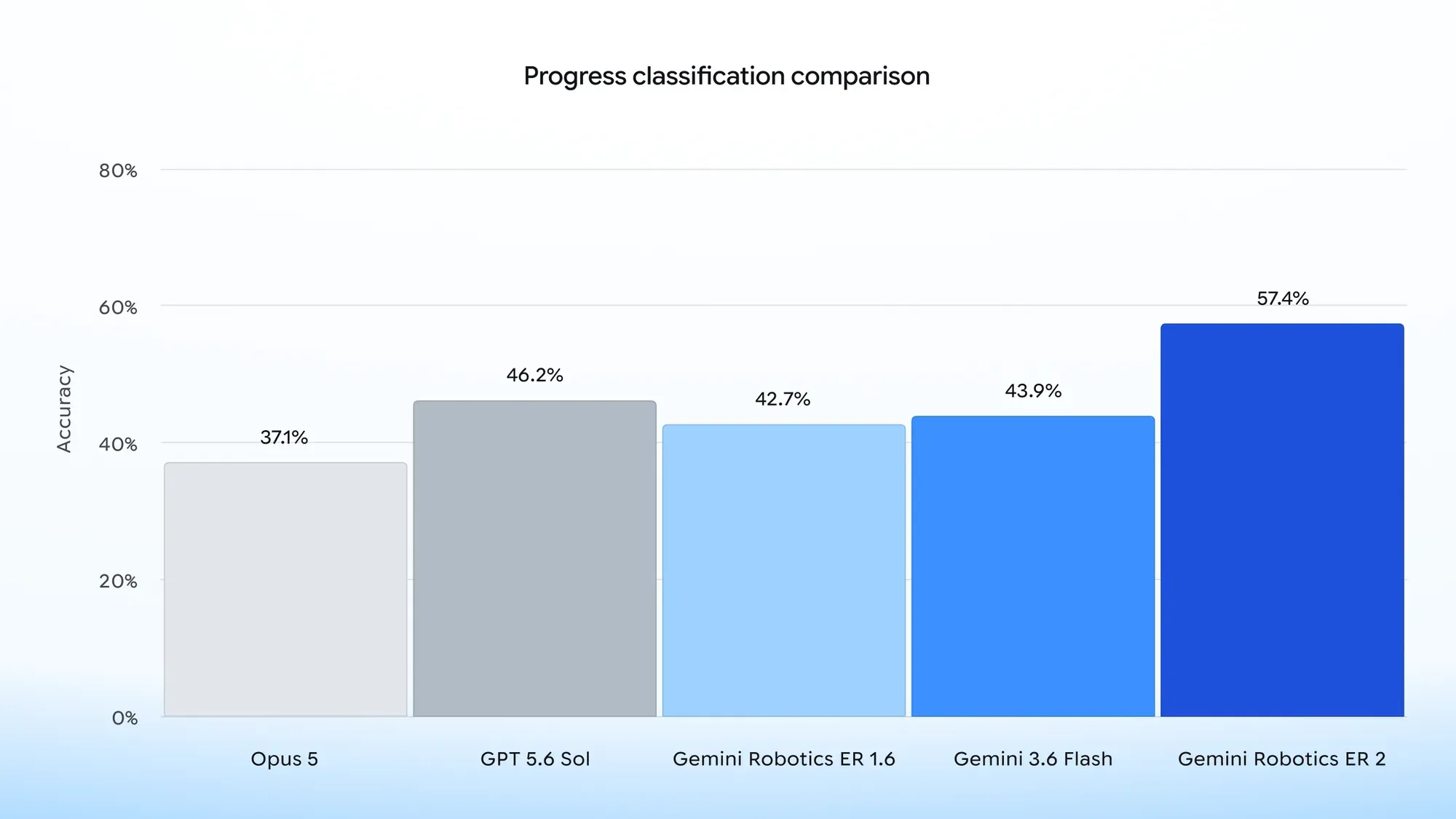
Perceptron's release lands in the same month that Google pushed its own robotics model family forward. Google's Gemini Robotics ER documentation describes ER 2 as a model for embodied reasoning: spatial reasoning, video understanding, task orchestration, instrument reading, pointing and function calling. Google's July release post says ER 2 can track task progress from video, identify moments such as when to stop pouring, and coordinate multiple robots through higher-level reasoning.
Google's reported numbers are first-party claims too. In its release post, Google says Gemini Robotics ER 2 reached 57.4% accuracy on progress classification and 91.3% accuracy on moment finding, with a 0.96-second mean absolute distance. Those are useful signals because they define the kinds of questions robotics reasoning models are now expected to answer. A robot does not only need to know where a cup is. It needs to know whether a pour is complete, whether a handoff is safe, and whether a task has failed badly enough to stop.
But Google's model is distributed as a service through Google channels, not as open weights that another lab can freely inspect and adapt. Perceptron's release offers a different kind of value. It may not match Google's infrastructure, partner hardware access or safety resources. It does give outsiders a way to examine a model that claims to span video, reasoning and control.
That difference matters for industrial automation. Many factories and logistics operators do not want a model that simply performs well on a public benchmark. They want a model they can adapt to a fixture, conveyor, arm, camera angle, tote, tray, inspection routine or vehicle path. The more a task depends on local hardware and local exceptions, the more important fine-tuning and deployment control become.
Why broad video is tempting
Robot data is scarce because robots are slow, expensive and physical. A language model can train on text copied at internet scale. A robot model needs examples of objects being touched, moved, dropped, stacked, opened, poured, screwed, lifted or avoided. Each recorded robot trajectory has a cost in equipment time, engineering time and operational risk.
That is why video is tempting. The world already contains vast recordings of hands, tools, kitchens, warehouses, workshops, farms and maintenance work. Most of that footage has no action labels in a form a robot can directly execute. Still, it shows changes that matter: when an object is grasped, when a drawer opens, when a container fills, when two things collide, when a human pauses before trying another motion.
Perceptron's report says Isaac learns from video by predicting "percepts," compact representations of task-relevant changes in future observations. The report says the targets are derived automatically from later frames and that the construction of those targets remains proprietary. That is both the promise and the limit. If future-percept prediction gives the model better representations for control, broad video can lower the cost of learning new skills. If the private target construction does most of the work, the open checkpoint is useful but the full recipe is not fully reproducible.
This is where outside testing matters. A robotics lab can download the materials, run the provided evaluation tools, and see whether the model adapts to a new task with fewer demonstrations than competing open systems. A factory team can inspect whether the claimed interfaces map cleanly to its own cameras and control stack. Neither group has to accept a launch video as the whole story.
The benchmarks need careful reading
Perceptron says Isaac 0.5 averages 97.2% success on LIBERO, a benchmark for robot manipulation tasks, compared with 97.0% for NVIDIA GR00T N1.7 and 96.9% for Physical Intelligence's pi0.5 in the same comparison table. The company also says Isaac improved faster than competing open models after one training pass over a single expert demonstration on three unseen tasks.
Those numbers should be read as Perceptron's reported results, not as settled industry rankings. Robotics benchmarks are sensitive to task suites, observation setup, action representation, simulation fidelity, evaluation seeds and whether a model's training data overlaps with the test distribution. A one-point benchmark gap can be less meaningful than whether the robot recovers after a misgrasp, handles a confusing visual scene, or stops when a person enters the workspace.
The model card and report help because they expose more of those assumptions. Perceptron says Isaac's training mixture includes 529 source streams, with robotics and control representing 30.3% of direct scheduler mass but 79.6% of packed-token exposure after example construction and packing. That distinction is useful. It shows why counting source hours alone can mislead. A recorded hour and an optimizer-consumed token are not the same unit.
The same skepticism applies to "frontier" language. Perceptron says Isaac is at the frontier among open robot models. That may be a fair description inside the paper's chosen comparisons. It should not be confused with a claim that Isaac is the best robotics system overall, or that it has been independently proven in customer deployments. The safer reading is that Isaac 0.5 is a serious open checkpoint with enough accompanying material to deserve testing.
The industrial test is integration
Perceptron says it is working with customers across manufacturing, logistics, warehousing, security and mobility. That is plausible territory for a model that can read video, estimate task progress and generate actions. It is also where the release will face its hardest checks.
Industrial robots fail in boring ways before they fail in dramatic ways. A barcode label is half torn. A reflective part confuses a camera. A bin arrives rotated. A gripper slowly wears down. A worker places a tool in the wrong location. A lighting change makes the model less certain. The robot does not only need a better high-level plan. It needs a safe route from uncertainty to recovery.
For Isaac 0.5, the practical checklist is straightforward:
- Can a team reproduce the reported evaluations with the published code and checkpoint?
- Can the model adapt to a new robot body or camera layout with a small number of demonstrations?
- Can it expose uncertainty clearly enough for a controller or operator to stop risky actions?
- Can deployment teams audit failures without relying on a private service or hidden prompt chain?
- Can the model improve a real workflow after maintenance, safety and downtime costs are counted?
Those questions are less glamorous than a robot demo, but they are where automation budgets live. If an open model reduces the data bill for adapting a robot to a new task, it can matter even if it is not a complete robot brain. If it cannot survive messy local hardware and safety constraints, the release will still be useful research infrastructure, but not a shortcut to deployment.
The open robotics race is becoming testable
Isaac 0.5 is part of a broader shift in robotics. Foundation models for robots are moving from lab videos and vendor claims toward artifacts that other teams can inspect: model cards, weights, code, evaluation settings, deployment manifests and safety notes. Closed systems will still matter because large labs and robot makers control hardware, data and infrastructure. Open systems matter because they let smaller teams compare assumptions rather than only compare demos.
The near-term consequence is not a wave of general-purpose robots. It is a better argument about data. If Perceptron's video-heavy recipe holds up outside its own report, robot learning may become less dependent on collecting thousands of costly teleoperated hours for every new skill and embodiment. That would lower one of the barriers keeping flexible robots stuck in pilots.
The harder evidence comes next: replication, third-party evaluations, real hardware adaptation and customer deployments that publish enough detail to separate reliability from launch language. Isaac 0.5 gives the robotics field something concrete to test. For an open-weight model, that is the point.
Comments ()