
Salesforce gives enterprise agents a shared skill registry
Salesforce's Winter '27 announcement turns enterprise agent work toward reusable skills, packaged plugins and orchestration across Slack, developer tools and other agent systems.
Salesforce has put a clearer shape around how it wants enterprise AI agents to move from demos into governed work: give them reusable skills, package those skills with connectors and hooks, then let them run across Slack, developer tools and other agent systems.
The company published its Winter '27 product announcement on August 31, 2026. Salesforce says the release includes Agent Skills and Plugins, Slack Code, third-party Agentforce orchestration, Informatica Headless access through VS Code, Cursor, Slack and MCP servers, and several business-specific agent templates. The broader Winter '27 release is scheduled for general availability on October 12, 2026.
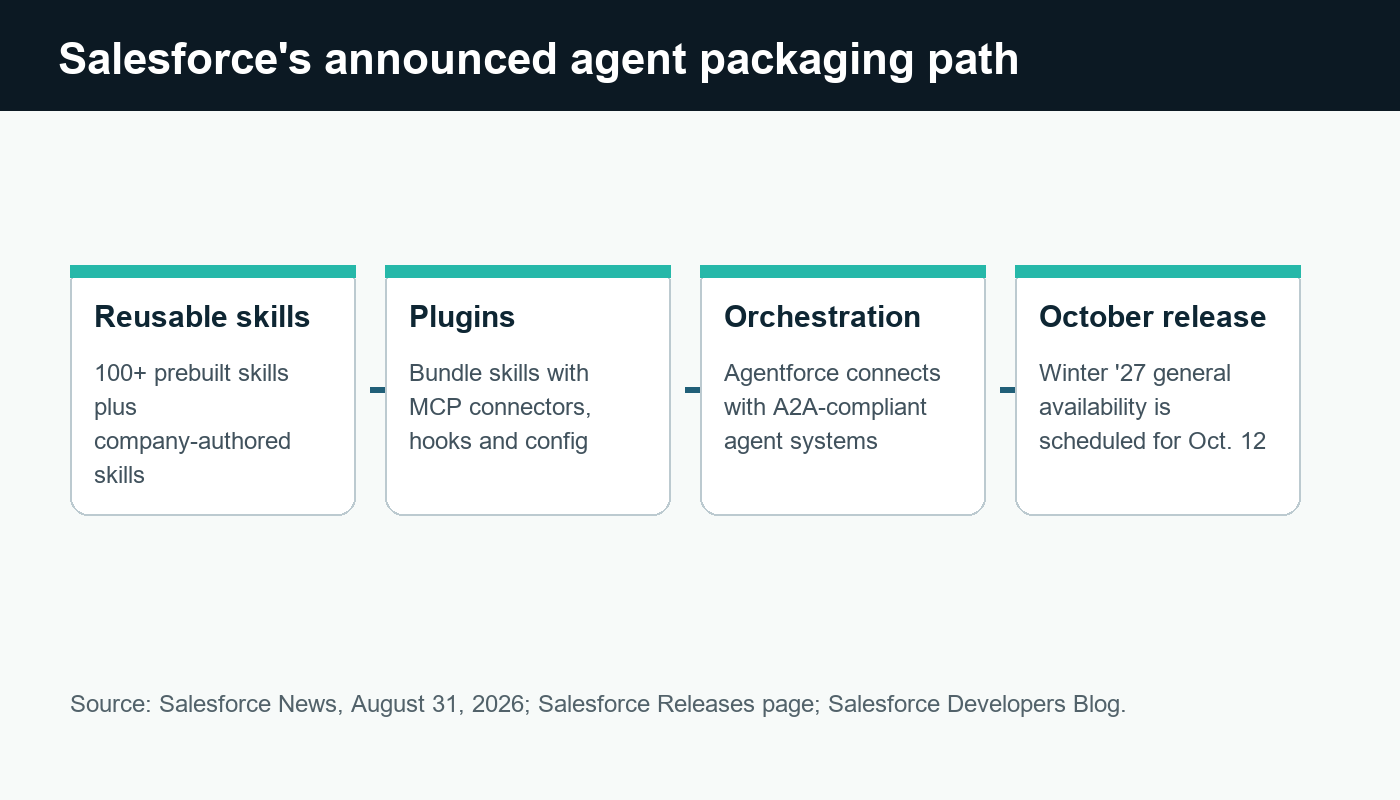
The freshest developer-facing detail is the skill registry. Salesforce says it has launched with more than 100 prebuilt skills for common platform workflows, and that companies can author and publish their own skills into the same registry. It also says plugins can bundle skills with MCP connectors, hooks and configuration, starting with a Salesforce Development plugin live in the Claude Code marketplace.
That is a company claim, not independent proof that the system is safe or widely adopted. It is still material because it changes the unit of agent work. Instead of each agent guessing how a company handles setup, service, commerce or data tasks, Salesforce wants the repeatable capability to live in a maintained package.
| Salesforce item | What it changes |
|---|---|
| Agent Skills and Plugins | Reusable skills can be packaged with MCP connectors and configuration. |
| Slack Code | Salesforce says coding work can happen in shared Slack code channels. |
| Third-party orchestration | Agentforce can connect with A2A-compliant agents from other vendors. |
| Informatica Headless | Developers can reach governed enterprise data from tools such as VS Code and Cursor. |
The pattern echoes Salesforce's earlier Headless 360 MCP work. In a July developer post, the company said its Headless 360 MCP Server exposed four tools, Discover, Describe, Dispatch and Dispatch Read Only, instead of making a model choose from thousands of platform actions. The same post said hosted MCP transactions run as the authenticated user, with Salesforce object permissions, field-level security, sharing rules, profiles and permission sets still applying.
That permission model matters more than Salesforce's release language. An enterprise agent that can book appointments, update records or assemble quotes is only useful if the business can tell what it is allowed to touch, who approved the package, and where the action was recorded.
The unresolved part is adoption. Salesforce says some pieces are live today and cites production examples, while the full seasonal release lands in October. Buyers still need to test whether the promised registry and orchestration model works inside their own permission structure, budget rules and review process.


Comments ()