
Claude Fable 5.1 ties coding gains to data custody
Anthropic's Claude Fable 5.1 launch links long-running coding claims, cheaper cache reads and customer-controlled monitoring data.
Anthropic's Claude Fable 5.1 release changes the enterprise model decision by pairing stronger long-running coding claims with cheaper cache reads and a new way for customers to hold the monitoring data.
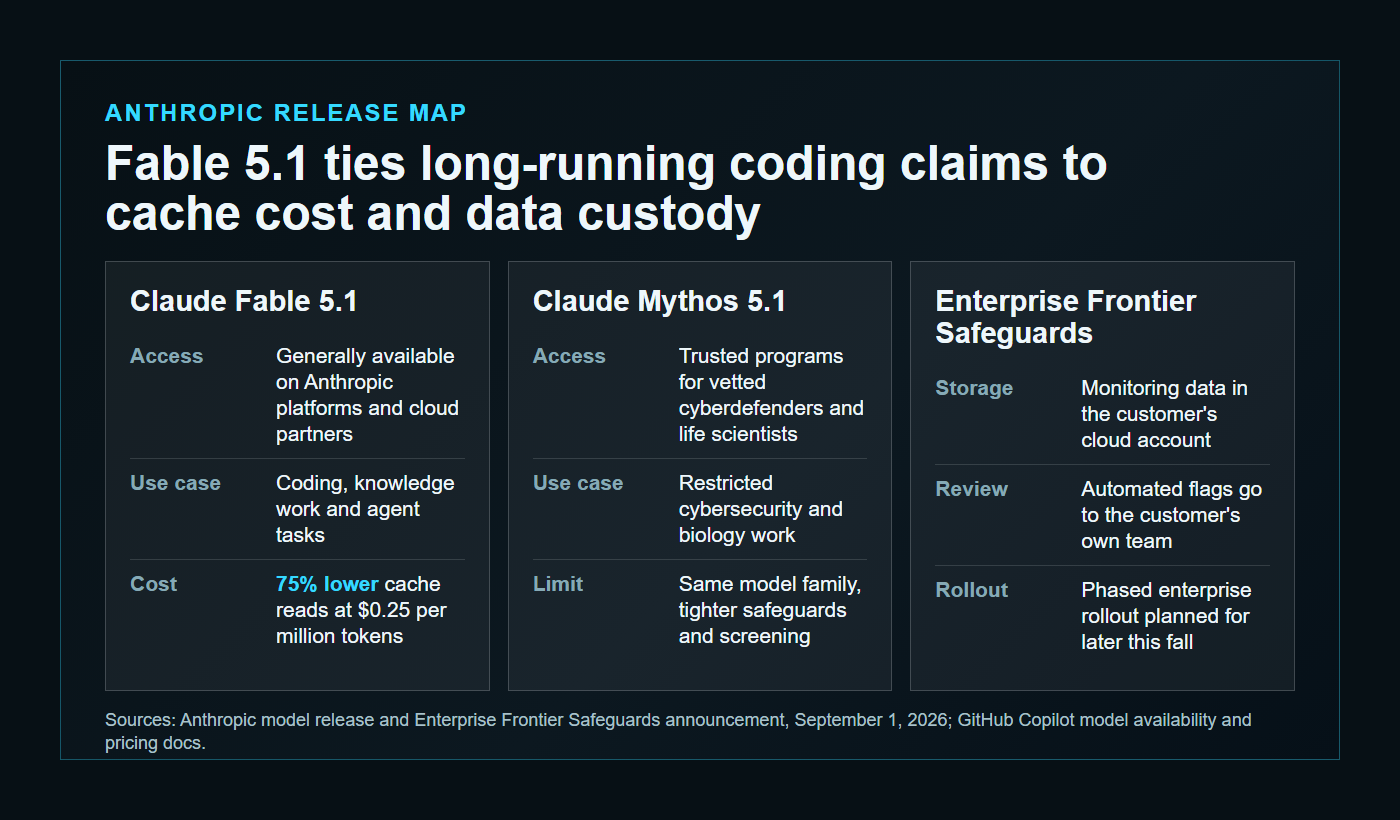
Anthropic lists the release on September 1, 2026. The company says Claude Fable 5.1 and Claude Mythos 5.1 are the same underlying model, split by safeguards and access. Fable 5.1 is generally available. Mythos 5.1 is limited to trusted access programs for cybersecurity and life sciences, where the company says the model has higher-risk capabilities that need tighter controls.
The pricing change is narrower than the model launch, but it is the part that makes long-running agents easier to justify. Anthropic says Fable 5.1 cache reads now cost 75% less, at $0.25 per million tokens, while input and output pricing stays at $10 and $50 per million tokens. Its own August usage analysis says the change cuts typical Fable workloads by about 25% and highly agentic work by as much as 45%.
That matters because agent systems reuse context. A coding agent that searches a repository, drafts a plan, edits files, runs tests and revises after failure can process the same project context many times. Cache reads do not make the hard reasoning cheap, and Anthropic's numbers are vendor claims rather than independent measurements. They still identify the commercial pressure clearly: the more an agent loops over stored context, the more cache pricing shapes its cost.
The model is split by safeguards
Anthropic's release says Fable 5.1 improves several vendor-reported benchmarks, including Terminal-Bench 4.0, AutomationBench and CursorBench 3.2.0. The company says Fable 5.1 reached 55.8% on Terminal-Bench 4.0 and 73.4% on CursorBench 3.2.0, while Mythos 5.1 reached 60.9% on Terminal-Bench 4.0 with cybersecurity safeguards off for the evaluated task set.
The important distinction is access. Anthropic says Mythos 5.1 carries advanced cybersecurity and biology capabilities and is available only through vetted programs. Fable 5.1, the general release model, keeps production safeguards enabled. The same post says Fable 5.1 can now be used to identify software vulnerabilities but not to develop exploits for them, and that cyber safeguards should intervene around 60% less often per Claude Code session than the previous Fable 5 safeguards.
The company's own system card is doing more than legal housekeeping here. Anthropic says its testing found Mythos 5.1 stronger than Mythos 5 in chemical and biological risk evaluations, still below the next Responsible Scaling Policy risk tier, and stronger than any model it has released on cyber evaluations while remaining in the lower risk category of its Frontier Compliance Framework. Those are Anthropic assessments. Buyers still need their own tests before sending sensitive work through a model that can use tools for hours.
Data custody becomes part of deployment
The retention issue is now attached to the product decision. GitHub says Claude Fable 5.1 is available in Copilot across VS Code, Visual Studio, Copilot CLI, GitHub's coding agent, the Copilot app, github.com, mobile, JetBrains, Xcode and Eclipse. It also says the model requires data retention by default for Anthropic safety classifiers, with zero data retention available only for certain eligible enterprise customers.
GitHub's own docs make the administrative consequence explicit. Models outside GitHub's data retention agreement, including Claude Fable 5 and Fable 5.1, are disabled by default for Copilot Business and Enterprise default availability policies. In practice, an administrator has to decide whether the model's claimed gains are worth enabling a separate data-handling path.
Anthropic's answer is Enterprise Frontier Safeguards. The system is planned for phased rollout later this fall. Anthropic says it stores monitoring data in cloud infrastructure controlled by the customer, with customer-managed encryption keys and customer-run human review when automated systems flag serious misuse. The company says EFS will work across Claude Code, Claude Enterprise, the Claude Platform, Amazon Bedrock, Claude Platform on AWS, Google's Agent Platform and Microsoft Foundry.
This is the trade-off the release puts in front of AI teams. If long-horizon agents need persistent monitoring to catch misuse across sessions, who holds the logs, who controls the keys and who reviews the flagged activity?
For developers, Fable 5.1 is worth reading as a packaging signal. Frontier coding models are being sold with benchmark charts, context economics and deployment controls in the same bundle. The model may write the patch, but the buying decision now reaches into storage, audit rules and which teams are allowed to see the agent's trail.
Anthropic's system card and alignment update add safety context; GitHub's supported-model and pricing documentation describe its Copilot conditions.


Comments ()