
Isaac ROS 5.0 brings agents into robot development
NVIDIA's Isaac ROS 5.0 release brings agent-ready workflows to ROS developers while extending GPU-accelerated robotics packages across Jetson hardware.
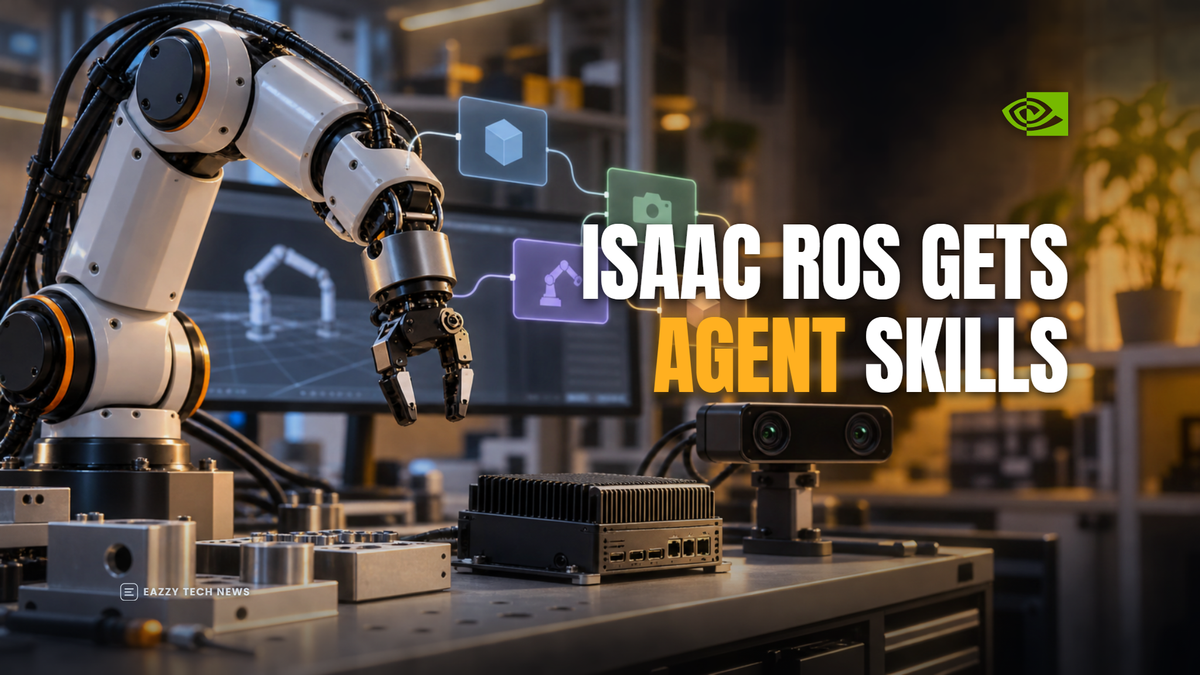
NVIDIA has released Isaac ROS 5.0 with agent-ready workflows for robot developers, giving the open ROS ecosystem new tooling for setup, migration, perception tuning and deployment on Jetson hardware.
The company announced the release on September 22 at ROSCon 2026 in Toronto. Isaac ROS is NVIDIA's set of GPU-accelerated packages built on Robot Operating System 2, the open framework widely used to build and connect robot applications. NVIDIA says the new version is free and open source.
The release matters because it moves "agentic" development from general coding help toward the robotics build process itself. In NVIDIA's framing, Isaac ROS 5.0 helps human developers and AI agents work on the same robotics stack: setting up environments, migrating workflows, tuning perception models and turning a common manipulation pipeline into a reusable skill.
What changed in Isaac ROS 5.0
NVIDIA's release describes several practical changes, with different levels of maturity and proof behind them:
- New platform support: Isaac ROS 5.0 supports ROS Lyrical and Ubuntu 24.04, giving teams a current ROS route while keeping NVIDIA acceleration available.
- Shared data handling: NVIDIA says it worked with the Open Source Robotics Alliance on a standard data-handling interface for ROS Lyrical so robotics software can move demanding data across different hardware, including GPUs.
- Agent-ready skills: New Isaac skills cover development setup and manipulation workflows, while documentation is being prepared so AI agents can understand Isaac ROS tasks more directly.
- Perception tuning: A FoundationStereo fine-tuning skill is meant to help adapt a stereo perception model to a developer's cameras, environment and robot application.
- Pose estimation speed: NVIDIA says FoundationPose now has an agent-ready inference library that can track object position and orientation up to 5.5 times faster.
The most concrete product shift is the packaging of repeated robotics work into skills. For example, pick and place, a standard manipulation flow that connects detection, depth estimation and object pose output, is now available as a standalone agent-ready skill. That does not make a robot autonomous by itself. It makes one common development path easier to express, reuse and inspect.
The open-source angle is doing real work
Robotics teams tend to be conservative about abstractions because code has to survive sensors, timing constraints, motor control and safety requirements. NVIDIA is trying to make its GPU tools feel native to the ROS world rather than like a separate proprietary island.
Its own ROSCon page puts the release beside talks on accelerated memory transports in ROS 2 Lyrical, contact-rich manipulation with Isaac Lab and Isaac ROS, and portable agentic robot policies. The documentation hub for Isaac ROS also lists release 5.0 as the current track, with packages spanning visual SLAM, scene reconstruction, object detection, pose estimation, DNN inference, cuMotion and deployment.
NVIDIA says partners are already building around the release. The examples include AgenticROS connecting Isaac ROS with Nemotron models and NemoClaw blueprints, RealSense optimizing depth cameras and an SDK for Isaac ROS and Jetson Thor, Intrinsic adding FoundationPose compatibility to an open machine-tending reference application, and Magna using Isaac ROS with Isaac Sim hardware-in-the-loop testing for manufacturing and mobility work.
Those examples should be read as ecosystem evidence, not independent performance proof. NVIDIA names the partners and their intended uses, but the release does not provide independent benchmarks for each deployment. The strongest verified facts are the release itself, the documented platform support, the agent-ready workflow direction and NVIDIA's own claims about specific library capabilities.
Jetson turns the release into an edge story
The other half of Isaac ROS 5.0 is deployment. NVIDIA says the release supports hardware from Jetson Orin Nano to Jetson Thor, which puts the same robotics stack across smaller developer systems and higher performance edge computers. That is important because robot software does not stay in a cloud notebook. It has to run near cameras, sensors, actuators and safety controls.
NVIDIA lists Mentee Robotics, Universal Robots, ROBOTIS, FieldAI and Noble Machines as companies using or integrating Isaac ROS on Jetson hardware. The common thread is on-robot perception and action: interpreting visual information, adapting to parts that are not perfectly positioned, guiding manipulation tasks or reducing cloud dependence for robot foundation models.
For developers, the useful test is whether the new agent-ready layer reduces the slow work around robotics integration without hiding the contracts that make ROS attractive in the first place. ROS teams need inspectable interfaces, reproducible environments and predictable deployment behavior. Isaac ROS 5.0 is NVIDIA's attempt to put AI agents into that workflow while keeping the result inside an open robotics ecosystem.
The next evidence to watch is adoption outside the launch post: public repositories, ROSCon technical feedback, partner case studies with measured latency or reliability data, and whether agent-ready skills become normal development aids or remain NVIDIA-specific demos.
Comments ()