
OpenAI turns AI plugins into a GitHub workflow
OpenAI's GitHub-synced plugin marketplaces show how workplace AI agents are starting to inherit software-release habits: repositories, manifests, admin policy and separate app permissions.
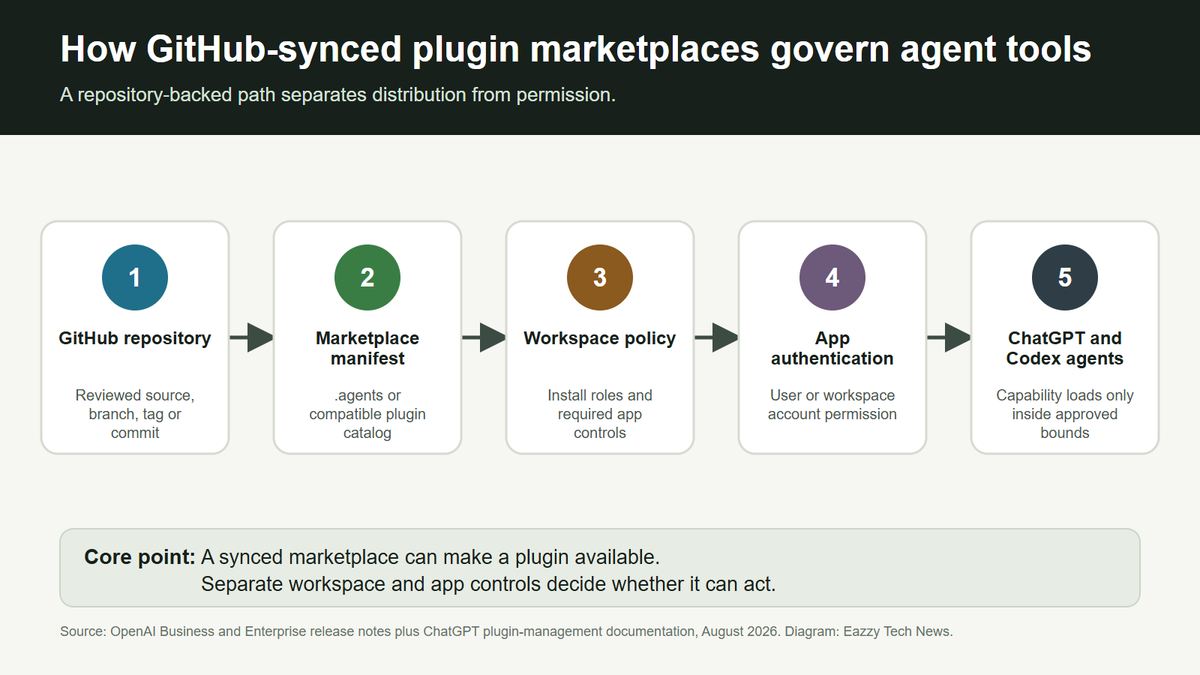
OpenAI has added GitHub-synced plugin marketplaces for ChatGPT Business, Enterprise and Edu workspaces. It is a small release-note item that says a lot about how workplace AI agents are being packaged.
The Enterprise and Edu release notes dated August 28, 2026 say workspace admins and owners can import plugin marketplaces from public or private GitHub repositories, keep them current through automatic daily sync, and request a manual sync from the marketplace screen. The parallel ChatGPT Business release notes add an important constraint: importing a plugin does not grant app access or connect members' accounts.
That distinction is the story. The update treats agent capabilities less like personal browser add-ons and more like software artifacts that belong in the same controlled path as code: a repository, a manifest, a review process, a deployment target, and a separate permissions model.
The change is about distribution, not another model
Most public attention around AI agents still goes to models, context windows, benchmarks, coding demos, and spectacular failures. Distribution is less dramatic, but it decides whether an agent becomes a repeatable workplace tool or a one-off experiment on one user's machine.
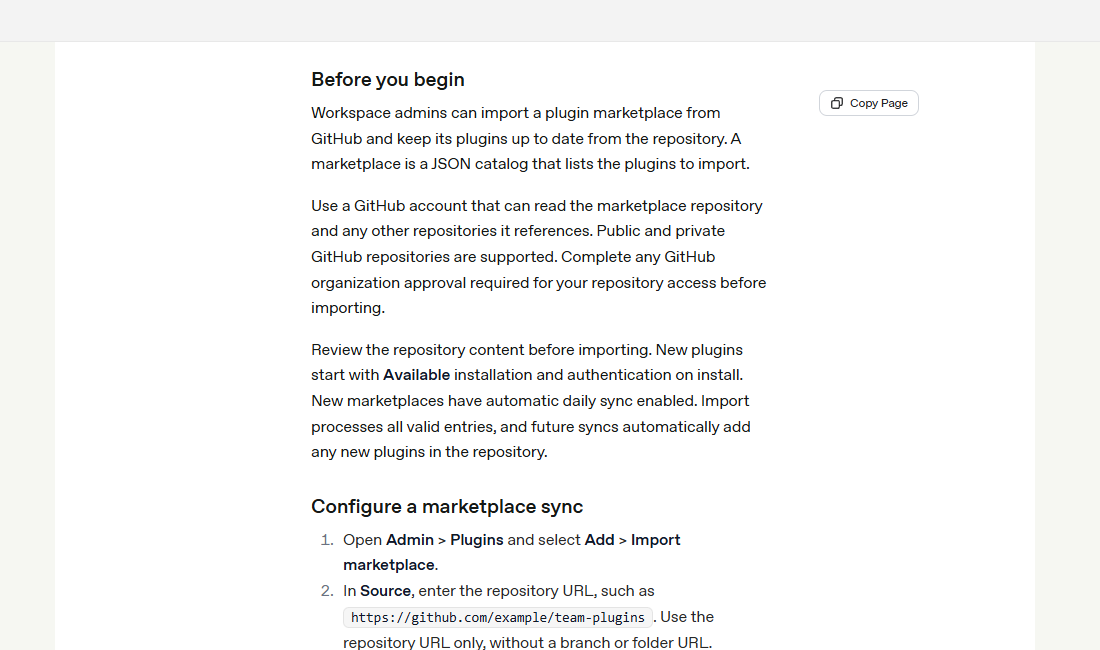
The new marketplace sync gives admins a path to publish a curated set of plugins from GitHub into a workspace directory. OpenAI's plugin management documentation says a marketplace is a JSON catalog that lists plugins to import. The same page says public and private GitHub repositories are supported, that the GitHub account used for import must be able to read the marketplace repository and referenced repositories, and that admins should review repository content before importing.
The workflow has familiar software-release pieces. The admin enters a repository URL, optionally narrows the path, optionally pins a branch, tag, or commit, authorizes GitHub access, reviews import results, then configures installation policy and required apps for each imported plugin. Daily sync can add new valid entries later, while "Sync now" lets an admin request an update without waiting for the scheduled refresh.
That is different from simply listing more plugins in a public directory. A GitHub-synced marketplace lets a team use repository history, code review, branch protection, security scanning, and normal engineering ownership around the capabilities that agents can load. The plugin may still be used inside ChatGPT or Codex, but the source of truth can live where developers already manage changes.
What a marketplace actually contains
The mechanics are plain. OpenAI's developer documentation says a plugin marketplace is a JSON catalog separate from the universal public directory. It can support authoring, testing, and private distribution. A plugin package can include a manifest, skills, lifecycle hooks, MCP server configuration, registered app mappings, and presentation assets.
For teams building with agents, that bundle matters because "plugin" is broader than a connector button. It can carry instructions that shape how an agent works, tools that call external systems, hooks that run at lifecycle moments, and metadata that tells users what the plugin is for. In Codex and ChatGPT Work, that can mean the difference between a generic agent and one that understands a team's release checklist, triage format, database rules, or internal approval path.
The supported marketplace formats also show what OpenAI is trying to make compatible. OpenAI's plugin-management page lists three accepted files:
| Marketplace file | What it supports | Why it matters |
|---|---|---|
.agents/plugins/marketplace.json |
Codex marketplace with a plugins array |
Native route for teams standardizing ChatGPT and Codex plugins. |
.claude-plugin/marketplace.json |
Claude-compatible marketplace with a plugins array |
Gives teams a migration path from existing agent setups. |
.claude-plugin/plugin.json |
Standalone Claude plugin when no marketplace manifest is present | Lets smaller plugin packages be imported without a full catalog. |
The same documentation says marketplace entries can reference native Codex plugins, Claude-compatible plugins, Agent Plugins 1.0 packages, or supported skill packages. That does not make every old agent customization automatically safe or useful, but it does make the distribution layer more portable. Teams that already wrote useful skills or tool bundles do not have to start from a blank directory just because the runtime changes.
The permission boundary is the useful part
The release note's most important sentence may be the one that prevents over-reading the feature. OpenAI says repository policy values do not override workspace settings, and app permissions plus authentication requirements still apply. Business release notes put it more directly: importing a plugin does not grant app access or connect members' accounts.
That means the GitHub repository distributes availability, not authority. A plugin can appear in the workspace directory, but a member still needs the relevant app connection and workspace permission before it can act on their data or services. Admins can review plugin settings, choose installation policies, and manage required apps. That is the line that keeps "ship the agent tool" separate from "let it touch customer, code, calendar, or payment systems."
This separation is likely to become a standard pattern for workplace agents. A team needs at least four layers to make agent extensions governable:
- A source repository that records who changed the plugin and when.
- A marketplace manifest that declares which plugins or skills belong in the workspace.
- Workspace policy that controls who can install or use each capability.
- App authentication that decides which real accounts and services a run can reach.
Remove any one of those layers and the system becomes harder to audit. A repository without workspace policy is just a convenient way to spread tools. Workspace policy without versioned source makes it difficult to know what changed between two agent runs. App authentication without a clear marketplace can leave users deciding one by one which tools are safe to install. The August 28 update ties those layers together without collapsing them into one permission switch.
Why GitHub fits this job
GitHub is not just a storage location in this design. It is a workflow assumption. Repositories already carry review rules, ownership files, issue discussion, commit history, release tags, dependency alerts, branch protection, and links to CI. Agent plugins need many of the same controls because they can change behavior even when the underlying model stays the same.
A prompt file can alter how an agent classifies a customer request. A tool schema can expose a new write action. An MCP server can place a database, CRM, inbox, or design system within reach. A lifecycle hook can run before or after a task. Those are software changes. They deserve the boring controls that software teams already know how to operate.
OpenAI's Codex developer command reference shows the same repository-first direction on the local side. The codex plugin marketplace commands can add a marketplace from GitHub shorthand, a Git URL, an SSH URL, or a local marketplace root. They can list, remove, and refresh marketplaces, with JSON output for automation-friendly workflows. That does not replace the workspace-admin import in ChatGPT Business or Enterprise, but it shows the same underlying idea: plugin distribution should be addressable, inspectable, and refreshable.
OpenAI's general plugins documentation also says plugins can be shared through marketplace sources, including a repository marketplace for a project or team. Earlier ChatGPT and Codex changelog notes described plugin sharing through marketplace sources for ChatGPT Business, with teams able to distribute reusable bundles that include skills, MCP servers, and lifecycle hooks. The August 28 Business, Enterprise and Edu update moves that idea deeper into workspace administration.
What builders should change now
For developers, the practical shift is simple: an agent capability should be treated like a small product. It needs a manifest, an owner, a reason to exist, test prompts, permission notes, and a review path. The model may provide the reasoning, but the plugin decides what the agent sees, which tools it can reach, and which team habit it follows.
Teams should avoid dumping every useful personal plugin into a shared marketplace. A better first catalog is narrow and boring:
- A support-triage plugin that reads the approved queues and drafts replies without sending them.
- A release-review plugin that loads the right checklist, pull-request rules, and deployment notes.
- A finance-analysis plugin that reads only approved reports and blocks direct payment actions.
- A design-review plugin that applies the team's component and accessibility standards without changing source files by default.
Each plugin should say what it can do, what it cannot do, which apps it requires, who owns it, and how changes get reviewed. That sounds administrative, but it is what turns a clever agent demo into something a team can use repeatedly without guessing which hidden instructions or tools are active.
There is also a migration lesson here. Because OpenAI supports Claude-compatible marketplace files and standalone plugin manifests, some teams can bring over existing agent work. That should not become a blind import. Compatibility only answers whether a package can be recognized. It does not answer whether the instructions are current, the tools are scoped, the authentication model is acceptable, or the plugin still fits the team's workflow.
The risk is stale or overbroad capability
Automatic daily sync cuts maintenance friction. It also raises the cost of sloppy repository governance. If a marketplace follows a moving branch, a merged change can place a new or modified capability in the workspace directory on the next sync. That may be exactly what a team wants for fast internal tooling, but it makes source review and branch policy more important.
OpenAI's configuration reference describes one local policy control that points in the same direction. The Codex configuration reference includes marketplace requirements such as allowed sources and a restrict_to_allowed_sources switch. When enabled, configured Git marketplace refreshes and plugin installs must match allowed source rules. Workspace-level controls are separate, but the principle is consistent: agent capability should come from known places.
The open question is not whether teams will customize agents. They already do. The open question is how much of that customization will become visible, reviewable, and owned. GitHub-synced marketplaces make the good path easier, but they do not do the governance work by themselves.
A small update with teeth
No single marketplace feature makes workplace agents safe. The model can still misunderstand a request. A plugin can still be poorly written. An app permission can still be too broad. A team can still approve a weak change because it is convenient.
But this update points to a more mature shape for agent tooling. The useful unit is no longer just a chat prompt, a model choice, or an installed connector. It is a versioned capability bundle, distributed through a repository, imported by an admin, constrained by workspace policy, and activated only with the right app access.
That is less exciting than a new benchmark score. It is also closer to how AI agents become part of real work.


Comments ()