
a16z Raises $1.1 Billion for AI Infrastructure Hardware
Andreessen Horowitz has raised a dedicated $1.1 billion fund for AI's physical infrastructure, shifting capital toward chips, memory, networking, data centers and power.
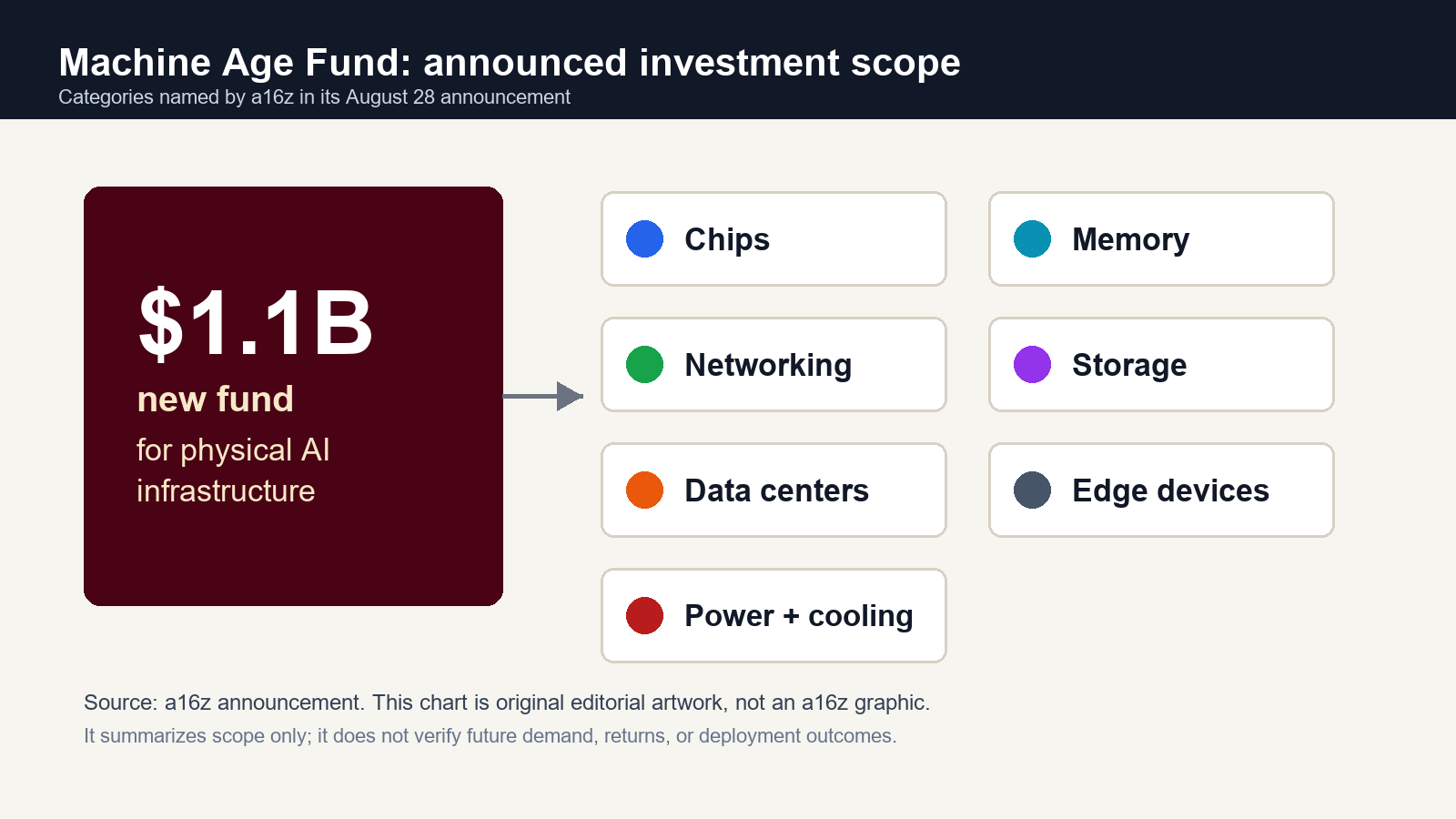
Andreessen Horowitz has raised a dedicated $1.1 billion Machine Age Fund for the physical infrastructure behind AI. The firm posted the announcement on August 28, 2026, saying the fund will invest in chips, memory, networking, storage, data centers, robotics, home AI appliances, edge devices, power, cooling, materials, electrical systems and real estate.
The confirmed fact is narrow but important: a major software-era venture firm has carved out a fund specifically for AI hardware infrastructure. a16z says the money is meant to back companies rebuilding the stack beneath AI systems, from silicon and interconnects to data-center power. The Wall Street Journal independently reported the same $1.1 billion size and described Machine Age as the firm's first dedicated hardware-infrastructure fund.
That makes this more than another AI funding announcement. The AI investment story has often been told through labs, apps and model releases. Machine Age shifts the focal point to the less glamorous constraints: the wafers, memory stacks, optical links, switch fabrics, substations, cooling loops and construction timelines that determine whether a model can be trained or served at scale.
What a16z confirmed
a16z says Machine Age will invest across "all of the computer infrastructure on which AI runs," explicitly naming chips, memory, networking and storage. It also includes full systems for AI, from data centers to edge and home devices. The firm frames the common problem as supply-chain capacity and the limits of physics and computer science.
The fund is led in part by partners with infrastructure backgrounds. The announcement names Raghu Raghuram, Martin Casado, David Ulevitch, David George and Ben Horowitz among the contributors. a16z points to Raghuram's VMware background and Casado's data-center and software-defined networking work as part of the reason the firm now wants hardware to be an "official motion."
The announcement also names existing or recent hardware-related bets such as Unconventional AI, Nexthop, Volta, Atoms, Heron Power and Mind Robotics. Those examples should be read as company positioning, not as proof that the new fund will solve the infrastructure shortage. Venture funds announce intention; fabs, racks and power campuses test whether that intention converts into capacity.
The infrastructure claim
a16z's argument is that AI demand is no longer just a software scaling curve. The firm claims compute density has risen sharply from H100-era racks to Rubin-era racks, that networking is pressing against copper limits, and that rack power has moved from the old 5-10 kW range toward 100-250 kW for current systems, with a path toward megawatt-class racks. The announcement links those figures to NVIDIA infrastructure material.
NVIDIA's own technical writing supports the broader direction, while remaining vendor-supplied evidence. In its Vera Rubin POD description, NVIDIA describes rack-scale systems that combine Rubin GPUs, Vera CPUs, ConnectX networking and BlueField DPUs across compute and switch trays. That is useful context for why investors are looking beyond individual chips. It does not independently verify a16z's future market thesis.
The distinction matters. Confirmed: a16z has raised a $1.1 billion fund and says it will target AI's physical infrastructure. Company claim: the supply side of hardware needs to move far faster than its historical growth pattern. Inference: if AI demand keeps rising, startups that improve power delivery, memory hierarchy, advanced packaging, networking, cooling or deployment speed could become strategically valuable suppliers. Unresolved: whether those startups can win against incumbents, survive long development cycles, and find customers before the market reprices AI infrastructure risk.
Why capital is moving down the stack
The hardware turn is also a response to where the bottleneck has moved. For a cloud provider, a model lab or a large enterprise, capability is increasingly tied to how much reliable compute can be brought online at a predictable cost. That means accelerator access, high-bandwidth memory, advanced packaging capacity, low-latency networking, rack integration, land, power interconnection, cooling and financing all become part of the same product problem.
WSJ's reporting adds outside context. It says Andreessen Horowitz has backed hardware companies before, but had not made hardware the main focus in this way. It also reports that semiconductor and autonomous-machine startups have raised roughly $100 billion over the past year, citing PitchBook data. That figure is independently reported, not confirmed by Eazzy Tech News in this run, so it should be treated as market context rather than a settled measurement.
The implication is straightforward: AI infrastructure is attracting capital because the constraints are physical. Software can be updated overnight. A substrate shortage, a transformer queue, a fab slot, a cooling retrofit or a high-voltage interconnect path cannot. If demand projections are right, the companies that reduce those constraints may matter as much as the model companies using the capacity.
The risk in the thesis
The weakness in a fund announcement is that it is not deployment evidence. Machine Age does not create a new fab, ship HBM, bring a substation online or deliver a sovereign AI factory by itself. It creates a pool of capital and a signal to founders that a16z wants hardware companies in its pipeline.
That signal can still matter. Venture capital does not usually fund the most capital-heavy semiconductor manufacturing by itself, but it can fund design tools, chip startups, optical networking companies, power electronics, cooling systems, deployment software and specialist infrastructure suppliers. Those are areas where the AI buildout is forcing old assumptions to break. Racks are hotter, networks are denser, model-serving economics are tighter, and data-center construction is becoming a strategic bottleneck rather than a back-office procurement issue.
The unresolved consequence is whether the new capital improves supply or mostly inflates valuations in already crowded infrastructure categories. If AI demand keeps accelerating, the fund may look early to a hardware cycle that was hiding under the model race. If demand slows, the same long hardware timelines could expose investors to expensive inventory, delayed facilities and startups that need more capital than venture markets want to provide.
For readers tracking AI infrastructure, the practical takeaway is not that one fund changes the supply chain. It is that a16z is treating the physical layer as a distinct investment category: chips, memory, networking, data centers, edge hardware, energy and cooling. That is a useful marker of where AI economics are moving. The next proof will not be another essay about the physical buildout. It will be whether the companies this fund backs can shorten the path from design win to deployed capacity.
Image rights: Featured image source: Wikimedia Commons, released under CC0 1.0 Universal Public Domain Dedication. Inline chart: original Eazzy Tech News editorial artwork based on the a16z announcement.



Comments ()