
The AI Data Center Is Becoming the Computer
AI infrastructure is moving from server upgrades to rack-scale systems shaped by memory bandwidth, networking, power delivery and cooling.
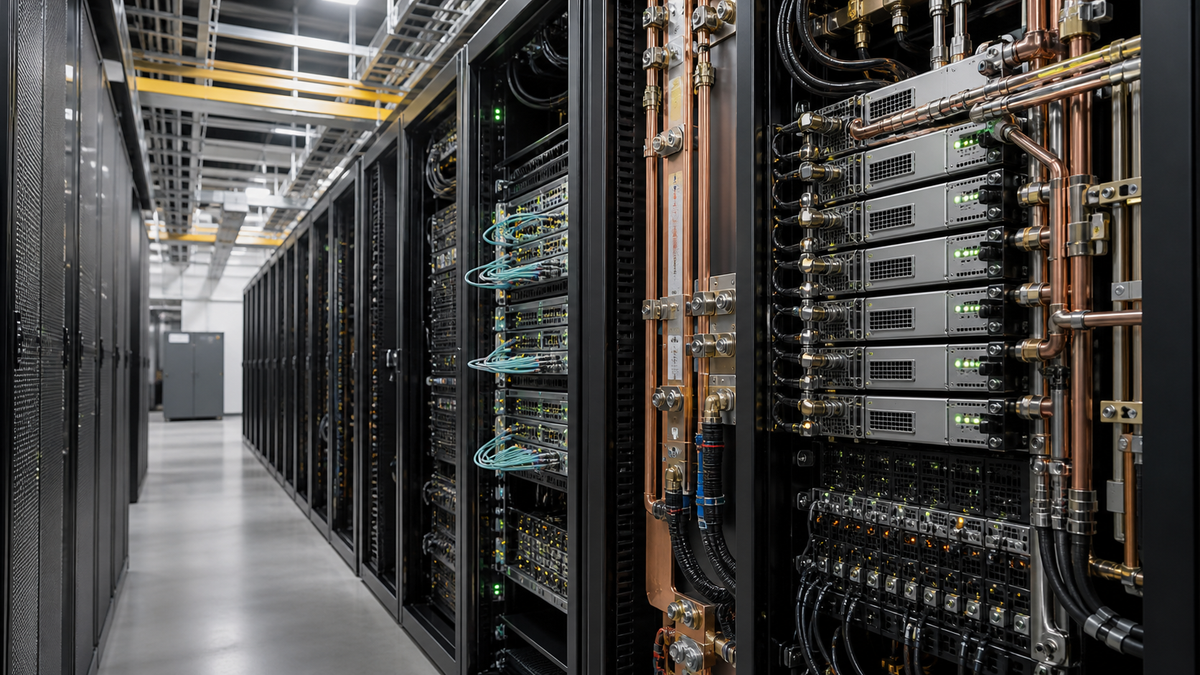
Rubin racks, HBM4 memory, custom cloud chips and liquid cooling all point to the same infrastructure shift: useful AI capacity is now designed from the chip package to the power room.
The most important AI computer in 2026 is no longer a single accelerator card. It is the rack, the pod, the network fabric, the cooling loop, the power chain and the software that keeps all of it busy.
That sounds like an infrastructure engineer's answer to a product question. It is becoming the product question. NVIDIA now describes its Vera Rubin NVL72 as a rack-scale system, not a faster server. Google says its Ironwood TPU platform is engineered as a holistic system supporting pods of up to 9,216 chips, and its later TPU 8t technical deep dive describes a 9,600-chip superpod for large pre-training and embedding-heavy workloads. AMD is positioning Instinct MI400 around rack-scale deployment and an open ROCm software foundation. Memory makers are pushing HBM4 because arithmetic units are useless when they wait for data. Facility suppliers are talking about direct-to-chip liquid cooling and 800 VDC power because the electrical and thermal envelope is now part of the accelerator roadmap.
The practical takeaway is simple but uncomfortable: AI capacity is being manufactured as a whole system. Buyers and builders who evaluate it only as "number of GPUs" will miss the economics that decide whether a cluster can train, serve and survive in production.
The rack is the new unit of competition
NVIDIA's language around Vera Rubin is useful because it makes the architectural shift explicit. In its January 2026 technical deep dive, NVIDIA says the platform co-designs GPUs, CPUs, networking, security, software, power delivery and cooling as one system, treating the data center rather than an individual GPU server as the unit of compute. The company describes the flagship Vera Rubin NVL72 as a rack-scale system that links 72 GPUs with CPUs, DPUs, SuperNICs and liquid-cooled infrastructure.
That is more than branding. Large language models and recommender systems do not spend all their time doing clean matrix multiplication on one chip. Training and inference involve memory movement, collective communication, token prefill, decode, KV-cache reuse, storage access, scheduling and failure recovery. As context windows grow and inference becomes more interactive, useful throughput depends on whether those pieces move together.
NVIDIA's August 24, 2026 performance-per-watt post makes the point through agentic inference. The company discusses SemiAnalysis AgentX, a benchmark designed to replay production-style coding-agent sessions with long-context prefill, KV-cache reuse, tool-call gaps and dynamic concurrency. NVIDIA reports that its own Vera Rubin NVL72 results reached up to 30 times higher AI-factory throughput per megawatt than GB300 NVL72 at a specific AgentX operating point, but it also notes that those Vera Rubin results were measured by NVIDIA and were pending SemiAnalysis review. That caveat matters. The number should be read as a vendor measurement, not settled independent proof.
Still, the benchmark framing is important even if one discounts the headline ratio. The metric NVIDIA emphasizes is not only tokens per second. It is tokens per megawatt at usable interactivity. That is the economic lens AI infrastructure is moving toward: how much useful work a fixed power budget can produce without degrading latency, reliability or operator control.
Memory is a system bottleneck, not a component line item
HBM4 shows why the rack cannot be understood chip by chip. SK hynix announced in September 2025 that it had completed HBM4 development and was readying mass production, claiming doubled bandwidth and 40 percent better power efficiency than the previous generation. Samsung later announced HBM4 commercial shipments, citing 11.7 Gbps transfer speed, potential up to 13 Gbps, a 4nm logic base die and up to 3.3 TB/s bandwidth per stack.
Those are company claims, but they line up with the same system pressure: AI accelerators need memory bandwidth and capacity as much as raw math. A rack that can hold more model state locally, move activations faster and reduce data movement can deliver better throughput per watt even before a buyer looks at software. HBM4 is not just "faster memory." It changes what model sizes, batch shapes, attention patterns and multi-chip partitions are practical.
This is also why advanced packaging has become strategic infrastructure. TSMC's 2025 annual report says its quality and reliability group completed certification of a CoWoS advanced packaging solution for 5.5x mask/reticle-size interposers in 2025 and would initiate volume production in 2026 to meet higher AI and HPC performance targets. In plainer language, modern accelerators increasingly depend on very large packages that combine compute dies, high-bandwidth memory and interconnect structures in ways a traditional monolithic chip cannot.
The supply chain implication is that AI infrastructure bottlenecks can sit outside the most visible processor roadmap. A cloud provider may have demand, capital and a signed chip allocation, yet still be limited by HBM stacks, packaging capacity, substrates, optics, power equipment or cooling installation. The "GPU shortage" label is too blunt for this phase of the market.
Networking is now part of the accelerator
Networking used to be easier to treat as the data center layer around compute. At AI scale, that separation breaks down. NVIDIA's Spectrum-6 and Spectrum-X Ethernet messaging is built around the idea that gigascale AI factories need the network to participate in performance, not merely carry packets. Oracle makes a similar argument from the cloud side: its March 2026 OCI post says its Acceleron network combines RDMA over Converged Ethernet, CNIC offload and a multiplanar design, and that its next OCI Supercluster integrates Rubin GPUs, Vera CPUs, BlueField-4 DPUs, ConnectX-9 SuperNICs and Spectrum-X Ethernet switches.
CoreWeave's June 2026 Vera Rubin announcement adds the operational layer. It says its first Vera Rubin NVL72 bring-up includes multi-rail, multi-plane networking, both InfiniBand and Spectrum-X Ethernet with RoCE, and 1.6 Tb/s of backend bandwidth per GPU. It also describes rack-level cooling controls and environmental sensors as cloud-operable resources rather than manual facility equipment.
None of this means Ethernet has "won" over InfiniBand or that every buyer needs the same fabric. The better conclusion is narrower: the network is now a scheduling, isolation and utilization system. It affects whether thousands of accelerators act like one training machine, whether inference tenants interfere with each other, and whether a service can keep GPUs productive while moving model state, activations and cached context through the cluster.
The cloud providers are converging on co-design, even when the chips differ
The rack-scale shift is not only an NVIDIA story. Google Cloud's Ironwood TPU post describes a system that combines Inter-Chip Interconnect, optical circuit switching, data center networking and aggregated HBM capacity. Its TPU 8t and 8i deep dive goes further into workload-specific hardware, including SparseCore for irregular embedding lookups and a 3D torus topology scaled to 9,600 chips in a superpod. That is the same thesis in a different stack: the accelerator is useful because the memory, interconnect, compiler and software runtime are designed together.
AWS makes the custom-silicon version of the argument. Its re:Invent 2025 announcement roundup said Trainium3 UltraServers were available, positioning them for large training and inference workloads. AWS's exact economics depend on workloads and customer contracts, but the strategic direction is clear: hyperscalers want more control over the full path from chip to service price.
AMD's Instinct MI400 page frames its own answer around HBM4, rack-scale systems and ROCm. The company's most important challenge is not only silicon performance. It is whether open software, networking choices and reference systems can make alternative accelerator deployments predictable enough for buyers who do not want all capacity tied to one vendor's stack.
For customers, this creates a more complex but healthier market. The old comparison was "which GPU is fastest?" The new comparison is closer to "which system gives my workload the best delivered performance, availability, migration path and cost per useful output?" That question includes accelerators, but it also includes memory headroom, model parallelism, compiler maturity, network topology, observability, energy contracts and who carries the operational risk when something fails.
Power and cooling are no longer back-office details
The facility layer is catching up because the rack is becoming denser than the buildings around it. Equinix's May 2026 direct-to-chip liquid-cooling explainer says high-density AI workloads can exceed 200 kW per rack and are trending toward 1 MW per rack, far above older 5-10 kW environments. It describes direct-to-chip cooling as four connected layers: IT equipment, in-row coolant distribution, facility water loops and the broader heat-rejection system.
Vertiv's October 2025 announcement with NVIDIA points to the power side. Vertiv says traditional 54 VDC in-rack distribution was designed for kilowatt-scale racks and cannot meet megawatt-scale accelerated-computing demand. Its 800 VDC power portfolio was planned for release in the second half of 2026, aligned with future NVIDIA Rubin Ultra platforms. Because the release contains forward-looking statements, it should be treated as a roadmap signal rather than proof of deployed capacity. But the signal is strong: power architecture is moving onto the AI roadmap.
This changes data-center construction economics. A building designed for conventional enterprise workloads may have space, fiber and backup systems, yet still be a poor fit for dense AI. The constraint may be utility interconnection, transformer lead times, chilled-water capacity, liquid-cooling maintenance, rack weight, safety procedures or the ability to service a live loop without taking down neighboring racks. In that world, "data center capacity" is not a generic commodity. AI-ready capacity is a narrower product.
What this means for operators and buyers
First, AI capacity planning needs to start with workload shape. Training a frontier model, serving a reasoning model with long context, running retrieval-heavy inference, fine-tuning open models and hosting embedding pipelines can stress different parts of the system. A buyer should ask where the workload waits: memory, network, prefill, decode, storage, power, cooling or orchestration. The answer determines whether more accelerators actually help.
Second, power should be treated as a performance budget. Tokens per megawatt, jobs per megawatt and revenue per megawatt are imperfect metrics, but they are closer to the real constraint than theoretical FLOPS. Vendor benchmarks can help frame the question, but they need workload-specific validation because published results often reflect selected models, precision formats, software versions and concurrency targets.
Third, deployment risk has moved up the stack. A rack-scale system can look excellent on a slide and still fail a buyer through firmware instability, thermal excursions, network congestion, driver mismatch, scheduler behavior or poor fault isolation. CoreWeave's emphasis on validation, rack control and software-defined cooling is partly marketing, but it also reveals where operational differentiation is happening.
Fourth, geography matters. Regions with cheap capital but constrained power will face different tradeoffs from regions with abundant renewable energy but limited advanced interconnect or semiconductor supply. For African operators, the lesson is especially practical: edge data centers and sovereign AI projects should not imitate hyperscale designs blindly. They should start from available grid capacity, cooling conditions, network latency, maintenance capability and the specific inference workloads that local customers can pay for.
Finally, procurement teams should avoid reducing the decision to a logo. NVIDIA's integrated rack-scale stack, Google's custom TPU stack, AWS Trainium, AMD Instinct and specialist AI clouds are converging on the same systems problem from different directions. The best answer for one workload may be the wrong answer for another. The market is moving from chip scarcity to system scarcity.
The useful question
The next phase of AI infrastructure will still be shaped by better accelerators. But the more durable story is that accelerators are becoming parts of larger machines. HBM4, CoWoS, optical and Ethernet fabrics, DPUs, custom CPUs, coolant loops, 800 VDC power and workload-aware runtimes are not accessories. They are the machine.
That should make the industry more careful about easy narratives. A company can announce a faster chip and still be late to useful capacity. A cloud can advertise a huge cluster and still struggle with delivered performance. A data center can have square footage and still lack the power and cooling envelope that AI needs. The constraint keeps moving because the computer keeps getting larger.
The right question for 2026 is not simply, "How many GPUs are available?" It is, "How much reliable AI work can this whole system produce, at what power budget, in which region, and with what operational risk?"
That is less tidy than a chip spec. It is also closer to where the economics now live.


Comments ()