
Court Vacates Pentagon's Anthropic AI Blacklist
A federal court vacated the Pentagon's Anthropic supply-chain-risk designation, turning an AI safety contract dispute into a First Amendment and due-process ruling.
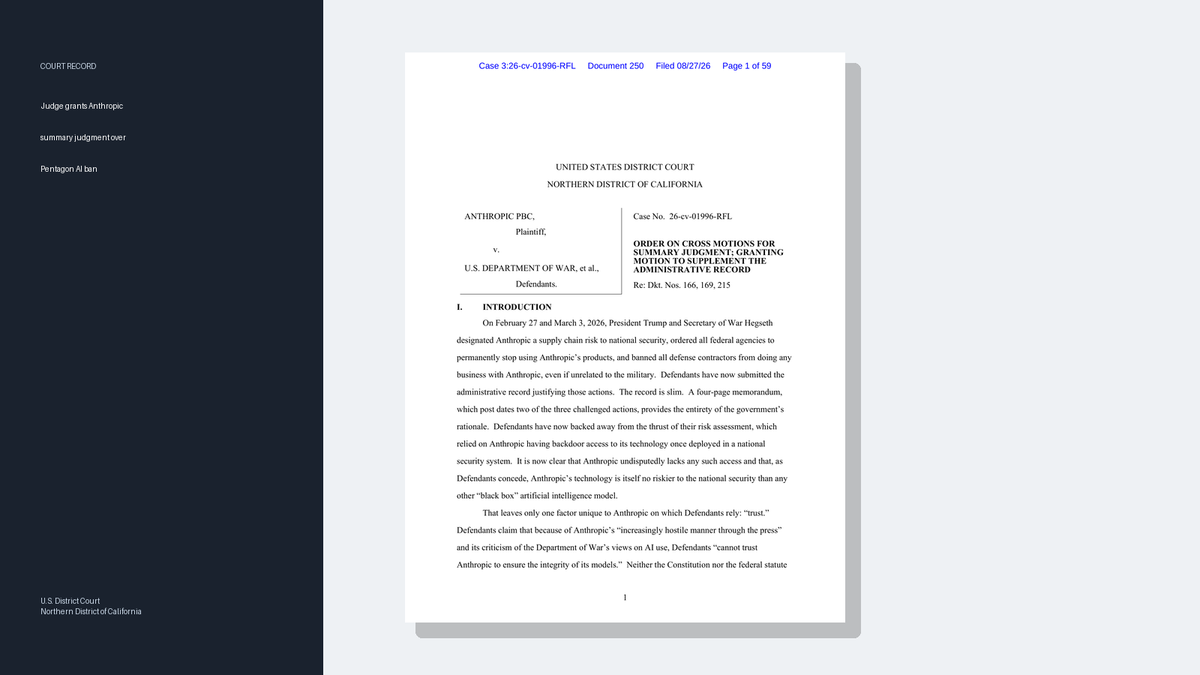
A federal court in California has turned Anthropic's fight with the Pentagon into a clear legal warning for AI procurement: the government may choose another vendor, but it cannot use a national-security label to punish an AI company for public safety objections.
In a 59-page opinion filed on August 27, 2026, U.S. District Judge Rita F. Lin granted Anthropic summary judgment on major constitutional and administrative-law claims. The court found that the challenged actions were unlawful retaliation under the First Amendment, denied Anthropic due process, and violated the supply-chain-risk statute the government invoked. A separate final relief order permanently enjoined enforcement of the challenged actions and vacated the supply-chain-risk designation.
That makes this more than a contract dispute. The confirmed legal development is that a U.S. federal court has set aside a sweeping AI blacklist tied to a company's stated limits on high-risk government use. The unresolved consequence is whether an appeal, a narrower procurement decision, or a different statutory route lets the government keep Anthropic out of sensitive military systems without repeating the same constitutional defects.
What The Court Actually Did
The court record names Anthropic PBC as plaintiff and the U.S. Department of War and other government defendants. According to the opinion, President Trump and Secretary of War Pete Hegseth designated Anthropic a supply-chain risk earlier this year, ordered federal agencies to stop using Anthropic products, and barred defense contractors from doing business with the company even outside military work.
The court did not say the government must use Claude, Anthropic's AI model family. It said the government lacked a lawful basis for the broad sanctions it imposed. Judge Lin wrote that the record did not support the theory that Anthropic could secretly sabotage deployed national-security systems, and that the government's own conduct undercut the claimed emergency because officials continued discussing Anthropic work after the designation.
The final relief order is specific. It declares the challenged actions unlawful under the First Amendment and Fifth Amendment, permanently enjoins most defendants from giving them effect, directs those defendants to rescind related guidance and communications, and vacates the supply-chain-risk designation. It also sets aside the portion of the Hegseth directive that barred military contractors, suppliers, and partners from commercial activity with Anthropic.
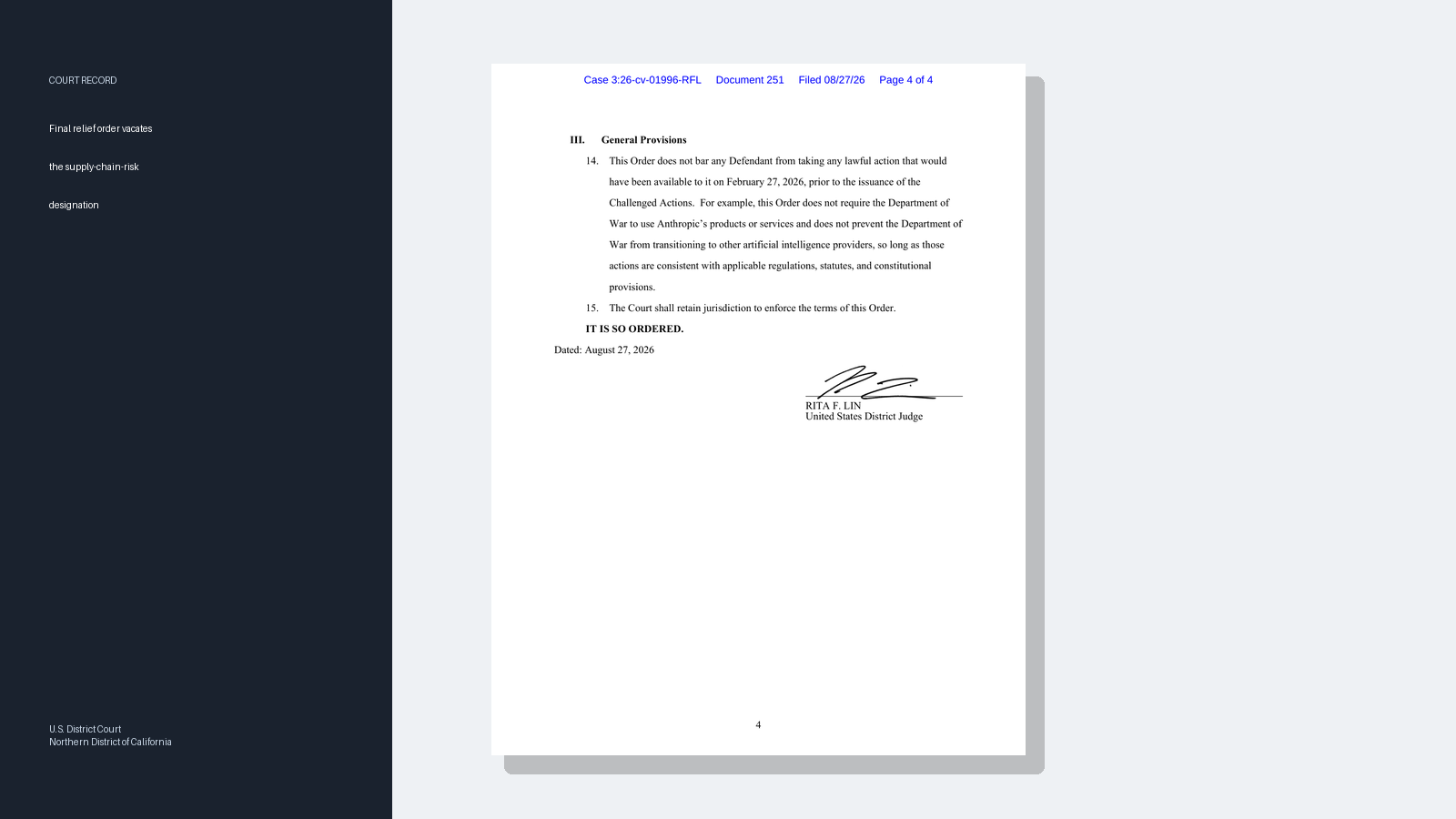
The same order includes an important limit: it does not prevent the Department of War from choosing another AI provider or taking lawful action that would have been available before the challenged directives. That point matters because it separates vendor discretion from retaliation. A public agency can decide that a model is unsuitable for a mission. It cannot, under this ruling, impose a government-wide penalty because a supplier criticized the agency's AI-use position.
Why This Is An AI Governance Story
Independent reporting from Axios, The Associated Press, The Verge, and The Washington Post frames the dispute around two categories Anthropic tried to keep off limits: mass surveillance of Americans and fully autonomous weapons. The court record is narrower than the policy debate. It focuses on retaliation, process, statutory authority, and whether the government produced evidence for the supply-chain-risk claim. But the policy fight underneath it is unmistakable: what happens when a frontier AI supplier refuses to remove safety constraints for national-security customers?
The government position, as described in the reporting and court materials, treated trust in the vendor as central. The court rejected the leap from disagreement to supply-chain threat. In plain terms, a model provider's public criticism of military AI use was not enough evidence that the company would poison, sabotage, or otherwise compromise its systems.
That distinction is important for cyber defense and model security. Supply-chain-risk authorities exist because software and infrastructure vendors can become national-security vulnerabilities. AI models add another layer of opacity: weights, training data, update channels, tool access, and deployment integrations can all create legitimate risk questions. The ruling does not erase those concerns. It says they need evidence and process, especially when the action threatens a company's federal business and is tied to protected speech.
The Political Risk Is Still Live
Anthropic welcomed the ruling in statements reported by Axios and AP, saying it wants to work productively with the government on national security. The White House and Pentagon had not immediately responded to AP and The Washington Post requests for comment in the checked coverage. Axios and AP both reported that the government is expected to fight the ruling, but no new appeal notice was identified in the checked primary court documents during this nightly review.
The ruling also sits beside another proceeding. AP reported that Anthropic has a separate, narrower case pending in the federal appeals court in Washington, D.C., involving a different Pentagon rule. That means the California order is material but not the final word on every government route for excluding Anthropic from sensitive AI work.
For other AI companies, the practical signal is direct. Written policies on prohibited uses, escalation, surveillance, lethal force, and human oversight are no longer only brand documents. In a public-sector conflict, they can become evidence in procurement decisions, constitutional claims, and national-security litigation. The ruling rewards neither side with a simple playbook. It confirms that safety objections can be protected speech, while leaving room for lawful agency decisions based on real mission needs and documented risks.
What To Watch Next
The immediate legal status is that the challenged blacklist has been enjoined and the supply-chain-risk designation vacated and remanded. The immediate governance question is narrower: can the government rebuild a lawful, evidence-based record for any future exclusion, or will the dispute push AI agencies toward less public contracting channels?
That question remains unresolved because the final order preserves lawful government discretion. The court blocked retaliation and defective process, not national-security review itself. If the government appeals, narrows its procurement decision, or cites different authority, the next round will test whether AI safety limits are treated as disqualifying friction or as normal terms in a mature vendor relationship.

Comments ()